It is no secret that English country style has been an eternal wellspring of inspiration for Ralph Lauren. And no clearer is this represented, than in some of the iconic editorial and catalogue imagery from the 1980s/1990s ‘Golden Era’ of Polo. For many, Ralph Lauren may well be a name which evokes an ideal of Americana, as manifested in its rugged denim offerings, faded flannel shirts and knitted sweaters with the Stars and Stripes proudly displayed. But for anyone familiar with a classic Bruce Weber campaign shot, it is clear how integral a wholly English aesthetic is to the brand. However, perhaps not unlike the English people themselves, this aspect of the brands identity can sometimes be rather understated. Especially so when it has to compete alongside bolder and more casual sportswear oriented ranges, which trade heavily off the cache of the Pony logo as an easily accessible status symbol. This reality has led to an interesting paradigm in which the brands quality ‘English’ offerings remain a sort of open secret, only to be truly appreciated by a niche of sartorially inclined connoisseurs.

It is fascinating then to listen to this 1993 interview with Ralph Lauren himself on Charlie Rose. As, between the various anecdotes about Ralph’s life story and his career, one theme consistently arises in the conversation: English Style and it’s relation to the world of Ralph Lauren. Amidst the talk, there is also a touching tribute to Ralph found in a clip of a speech given by Audrey Hepburn at a Fashion Lifetime Achievement Award ceremony in 1992:
“…As a designer, you conjure up all things I most care about: the country, misty mornings, summer afternoons, great open spaces, horses, corn fields, vegetable gardens, fireplaces, and Jack Russell Terriers. As a man, I respect you for your total lack of pretension.”
The world that Hepburn speaks of here is one certainly born out of a particularly English way of life. And, that she found a resonance in Ralph’s vision, is a testament to his ability to use clothes as a touchstone with which to muse upon such ideals.
Another telling exchange takes place halfway through the interview, in which Ralph talks about an English hacking jacket:
“A hacking jacket represented a life that I loved. It was old England. They look great. I don’t know what it was at the time, but I said, “You know, I’d love to have that.” I couldn’t find it in the stores. I said, “Where can I get that? Where can I get it?” You couldn’t get it anywhere, so I said, “I’d like to make that.” I made it so you can wear it.”
Now, a hacking jacket can appear to be quite an unassuming garment to the uninitiated, as at a surface level it is easy to misconstrue as a kind of odd variant of a blazer or sports jacket. But to those in the know, a hacking jacket is characterised by some lovely idiosyncratic details, usually in the form of ticket pockets, shorter lapels and a longer body with a flared skirt. Typically made up in mossy tweeds. It is a garment born out of the necessity of life on a country estate. A place where the practical concerns meet the desire for presentability, and looking ‘proper’. Subsequently, a timeless pattern is born. Ralph clearly recognised this synthesis between utility and sensibility, and how it creates garments with a certain sense of class and distinction.
Here today I have a beautiful original Ralph Lauren piece which perfectly captures such a design philosophy, in the form of this circa early 1990s Polo take on a classic English ‘Norfolk’ jacket.
As Norfolk jackets go, they can be quite varied in their styling, but are most typically characterised by a belted waist and raised panels that run vertically down the front. Originally made for shooting and field sports, they often have other details which lend themselves to such pursuits, like pleated and half belt backs with swing vents, or shoulder patches for resting stocks upon. In terms of cloth, heavy tweedy wools with windowpane or gun checks would be your go to. The result is something that exudes heritage, and certainly makes a statement. But with this type of statement comes a reality, whereby it begins to look more and more out of place the further that it leaves its country home. Indeed as classic as such a garment may be, heavier tweed jackets with eccentric details can often all too easily become ‘costume’ when worn outside of very particular contexts.
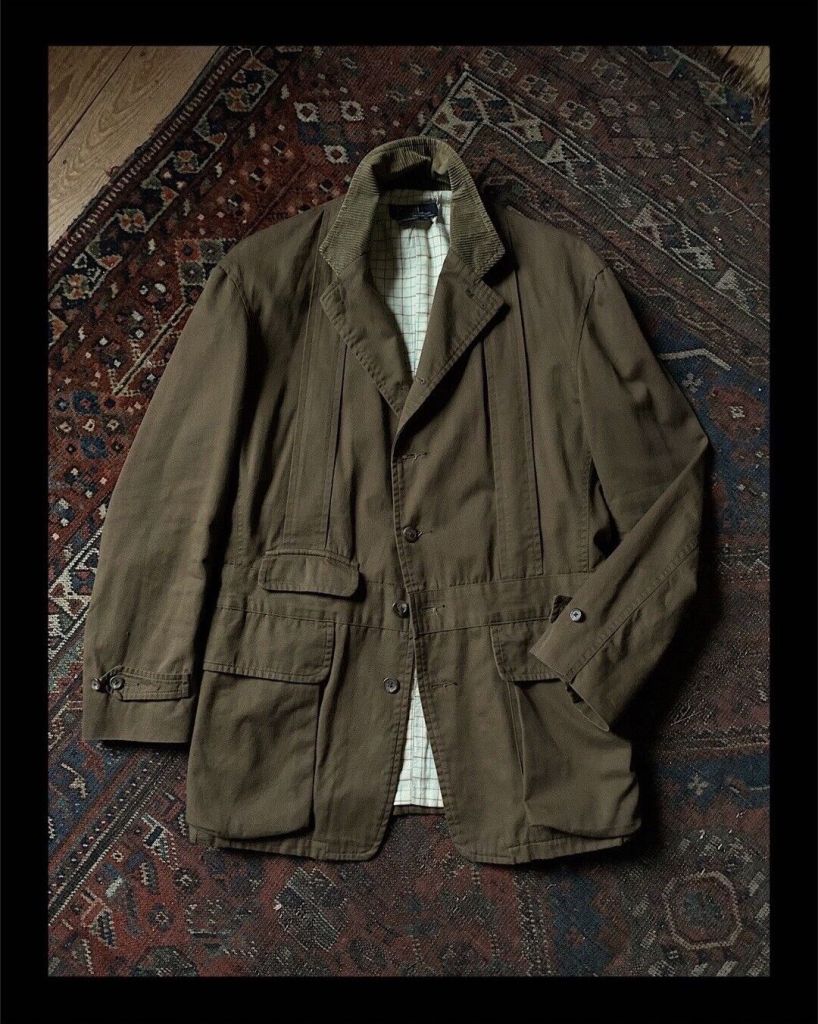
But herein lies the genius of this old Polo piece that I am spotlighting here today. It is a scaled back Norfolk that, whilst still preserving the essence of its origin, comes to us in a far more approachable format. Made up in a mid weight Olive Green cotton twill cloth, this Norfolk is just as good for ‘knocking about in’ as it is for looking smart for a meeting on the estate. It is certainly a very ‘homely’ jacket, with a cosy Tattersall lined interior, a ticket pocket that is perfect for a bit of loose change or a matchbox, and a corduroy collar that can be worn up and fastened by a detachable throat latch on windier days. There are other more subtle details too which I enjoy, like the flared button tabs at the sleeves, and the swing vents on the arms for added mobility.
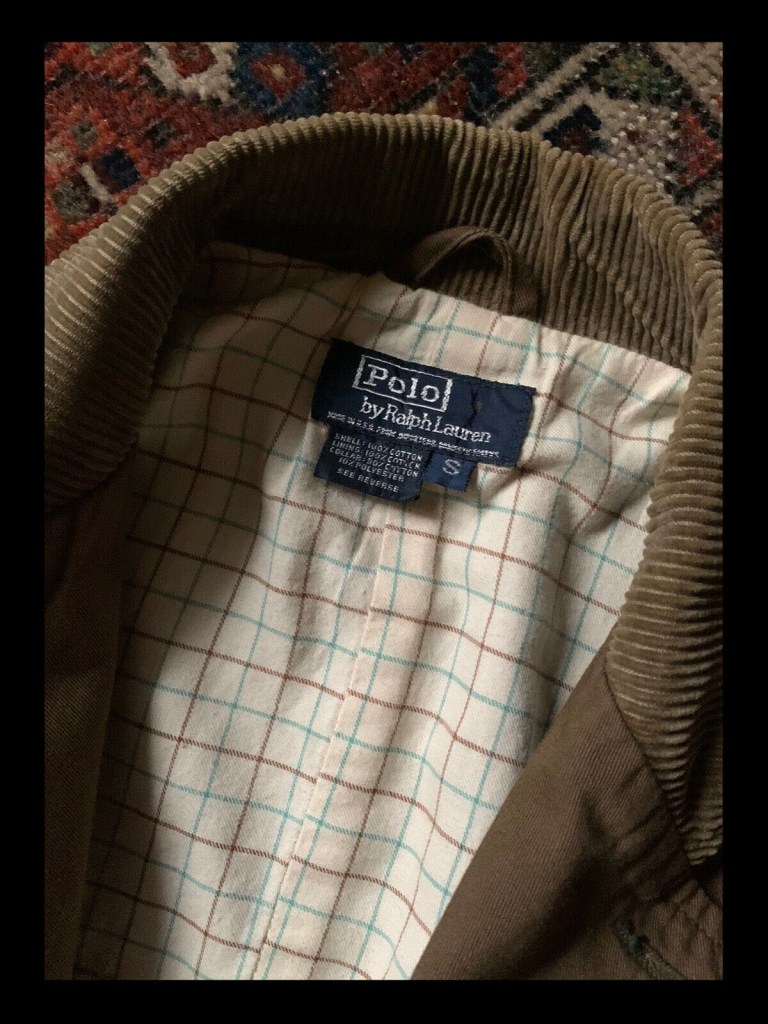
To top it all off, the jacket bares that lovely old Polo label with ‘Made in USA’ text written underneath the logo. This is a label that denotes a certain level of quality, not as easily found in contemporary RL offerings. It is one of those little tells you always look for when on the hunt for vintage gems. When you see it, you know you are in for a treat. And this totally characterful jacket is certainly no exception. Perfect for Town and Country!
So here I offer you: A Very English Jacket, Made in the USA.
Available to purchase in The Sartorium shop here
 The Sartorium Companion Journal