• About

The Sartorium Companion Journal

  • On the nuance of Safari Jackets, Featuring De Petrillo

    Sep 1st, 2024

    About five years ago I found myself wandering down Mount Street in Mayfair. It was my first time on the street, and I was a simple man with one mission: a visit to the flagship RRL store (an excellent store that is now no lonnger). At the time, the Porsche showroom marked the beginning of the street, a sight indicative of the enclave of luxury retail it was home to. As I walked further down, I was greeted by a stone statue depicting a Nymph like figure in front of a water feature, just outside of the grand Connaught hotel. Across the street was a rather novel display: a long line of well moneyed Chinese and Saudi tourists queuing up outside of the Goyard flagship, eager to get their hands on monogrammed luggage and bags. But, between all these rather ostentatious displays of opulence, one sight I saw left an impression on me above all else. It was in the window of the Tobacconist Sautter’s. Their display that day had a rather curious object situated in amongst the premium cigars and smoking related ephemera. It was a Safari Jacket. Back then, I thought this to be a bit puzzling, as the safari jacket is something I had only really seen as a kind of novelty item. An association perhaps stemming from the character Nigel Thornberry of ‘The Wild Thornberries’, which was a cartoon I grew up with. I think it was probably this connection that had subconsciously set in my mind the idea that the safari jacket was merely a kind of fancy dress fodder. So seeing one here in such an elevated environment slightly threw me off. Yet, with the way the jacket was styled on the mannequin (popped collar and belt casually tied to the side), it most certainly left an impression. So, while I may have ended up not purchasing anything from RRL that day, what I had seen in Sautter’s had surely planted in me a sartorial seed… 

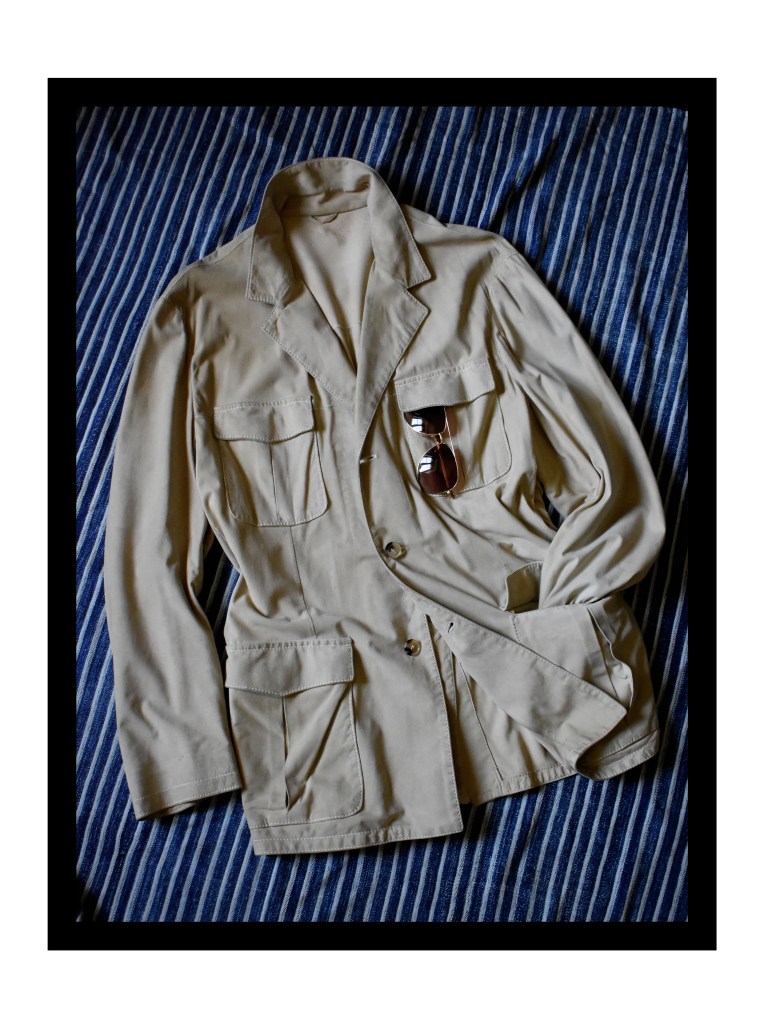
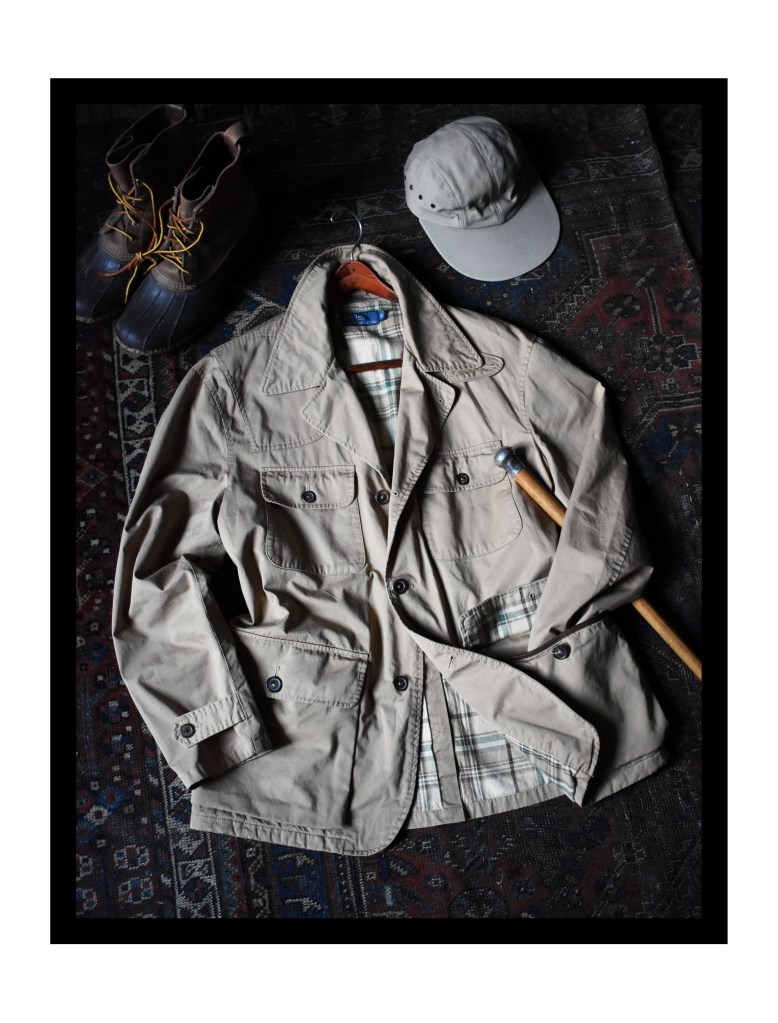
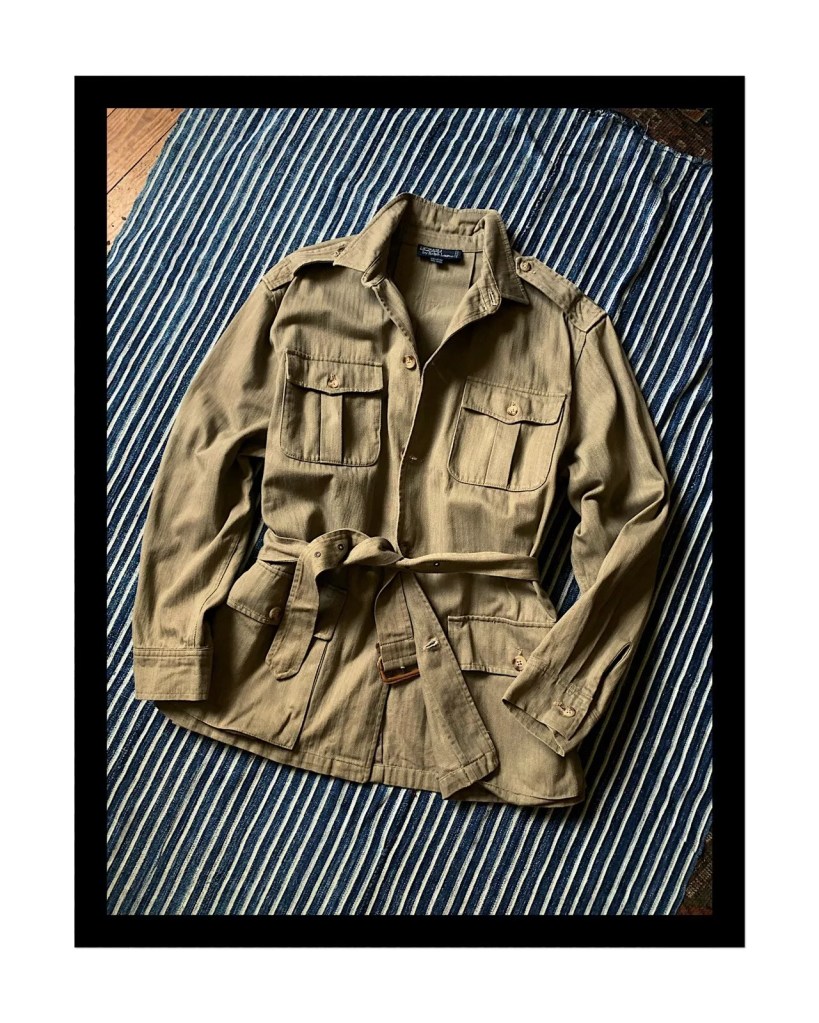
    And clearly that seed did grow, as the safari jacket has since become one of my most adored outerwear patterns. To me, it is one of those ‘ultimate’ jackets, in the sense that the possibilities of customisation are almost endless, and no two safari jackets are ever really quite the same. Here is a selection of some vintage ones I have sold in the Sartorium over the last year (By Polo, J Peterman, Pal Zileri and others):
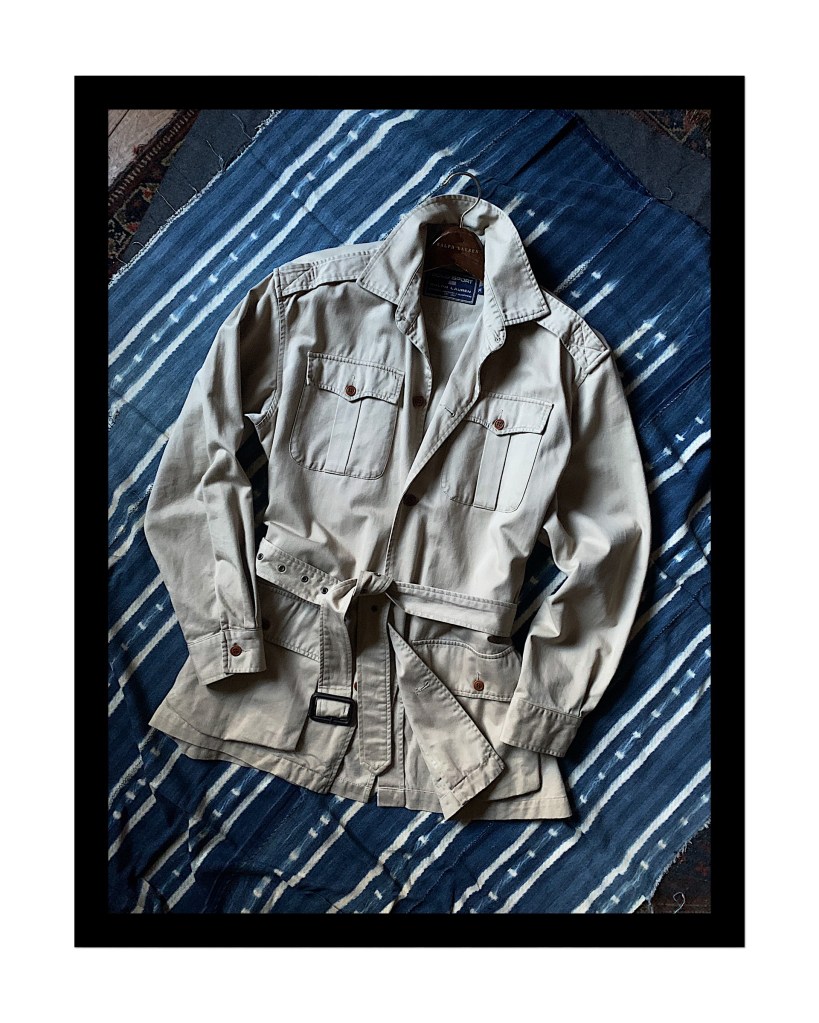
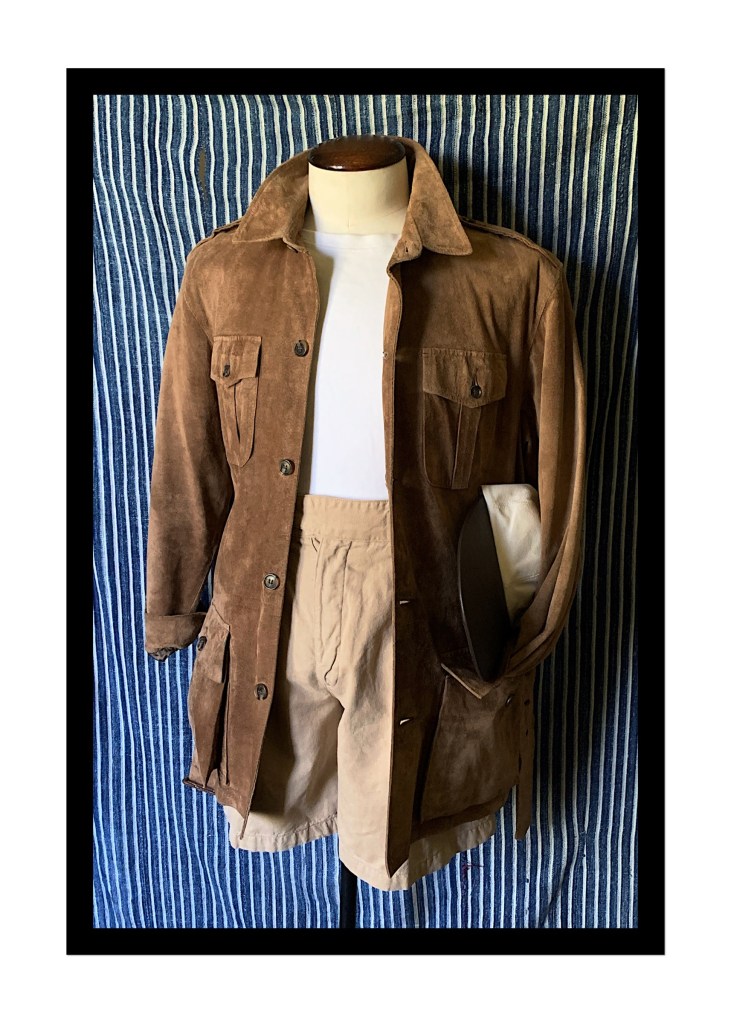
    At its core it is a ‘field’ jacket, and as such is typified by the four pocket layout on the front. But after that, a good safari jacket can really go in so many different directions. They can have fully detachable belts or half belts, epaulettes or none, bellows pockets or pleated pockets (or both!). Pleated backs and bi swing vents are a common feature but are not always present. Some come with large point collars that can be popped ‘just right’, whilst others have banded collars. Typically they are made up in a Khaki coloured cotton twill fabric, but experimentation over the years has shown that they can really be made up in just about anything. From soft calfskin suedes, to heavy wide wale corduroys, or even Woolen twills and tweeds. And indeed, the history of the garment in a fashion context is a testament to such versatility. 

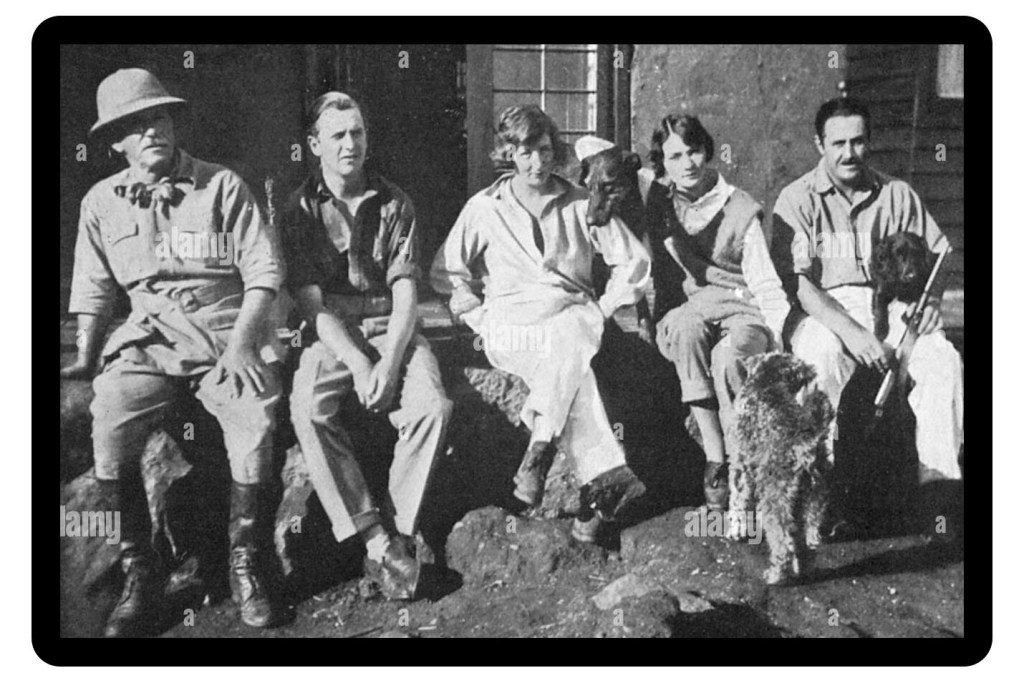
    They would first find cache in colonial circles like the ‘Happy Valley Set’ of of Kenya, where British Army bush jackets came to be worn in a civilian context after many had become enamoured with them in the tropical theatres of WW1. We can see a classic pattern being worn here by a one ‘Trevor Sheen’ in this 1926 photo featuring Lady Idina Hay and Earl Errol:
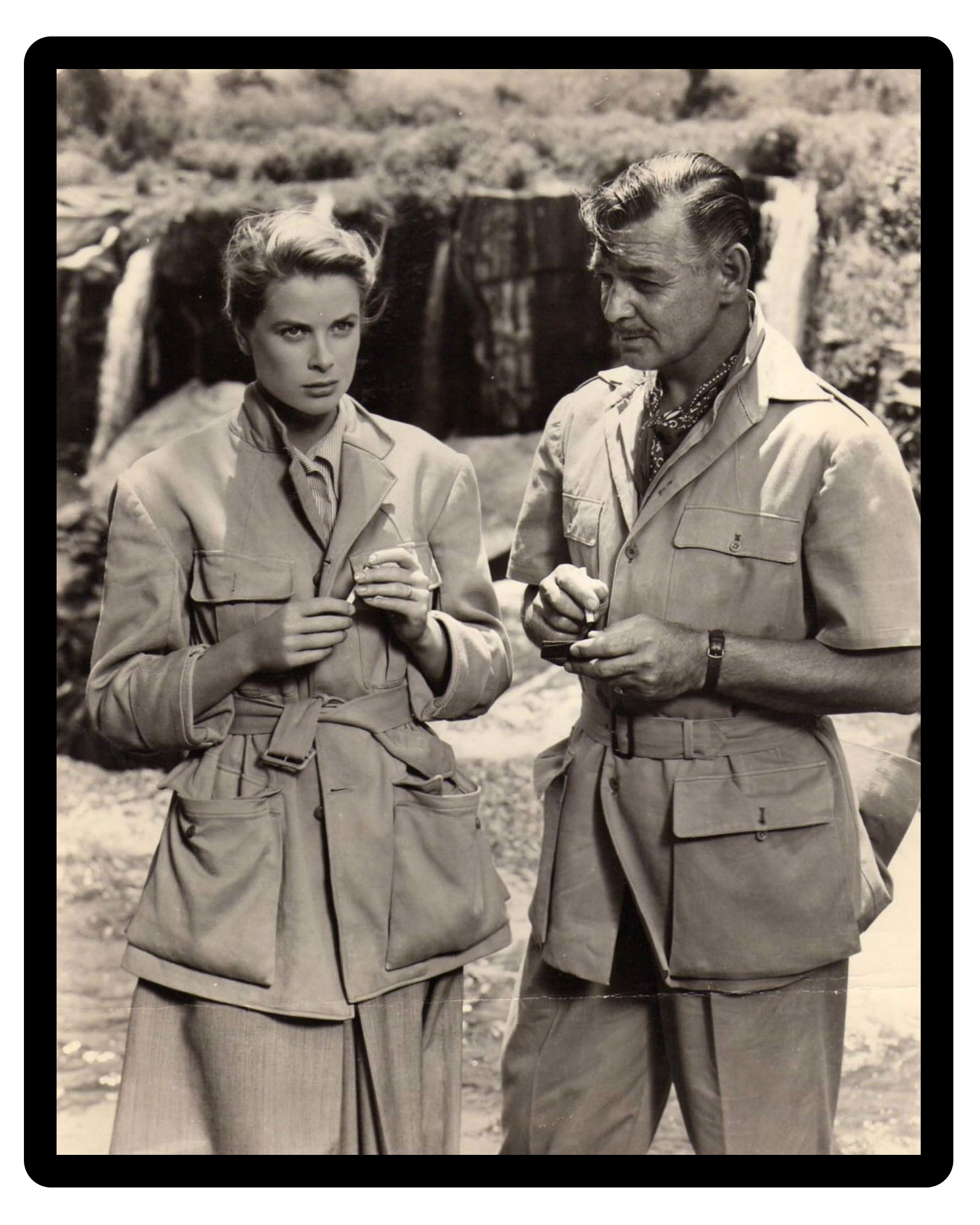
    Then the jacket would go on to yet more glamorous heights with Clark Gable donning one in the 1952 Hollywood film ‘Mogambo’. Shots of Ernest Hemingway hunting in Africa also come to mind when one thinks of this decade:
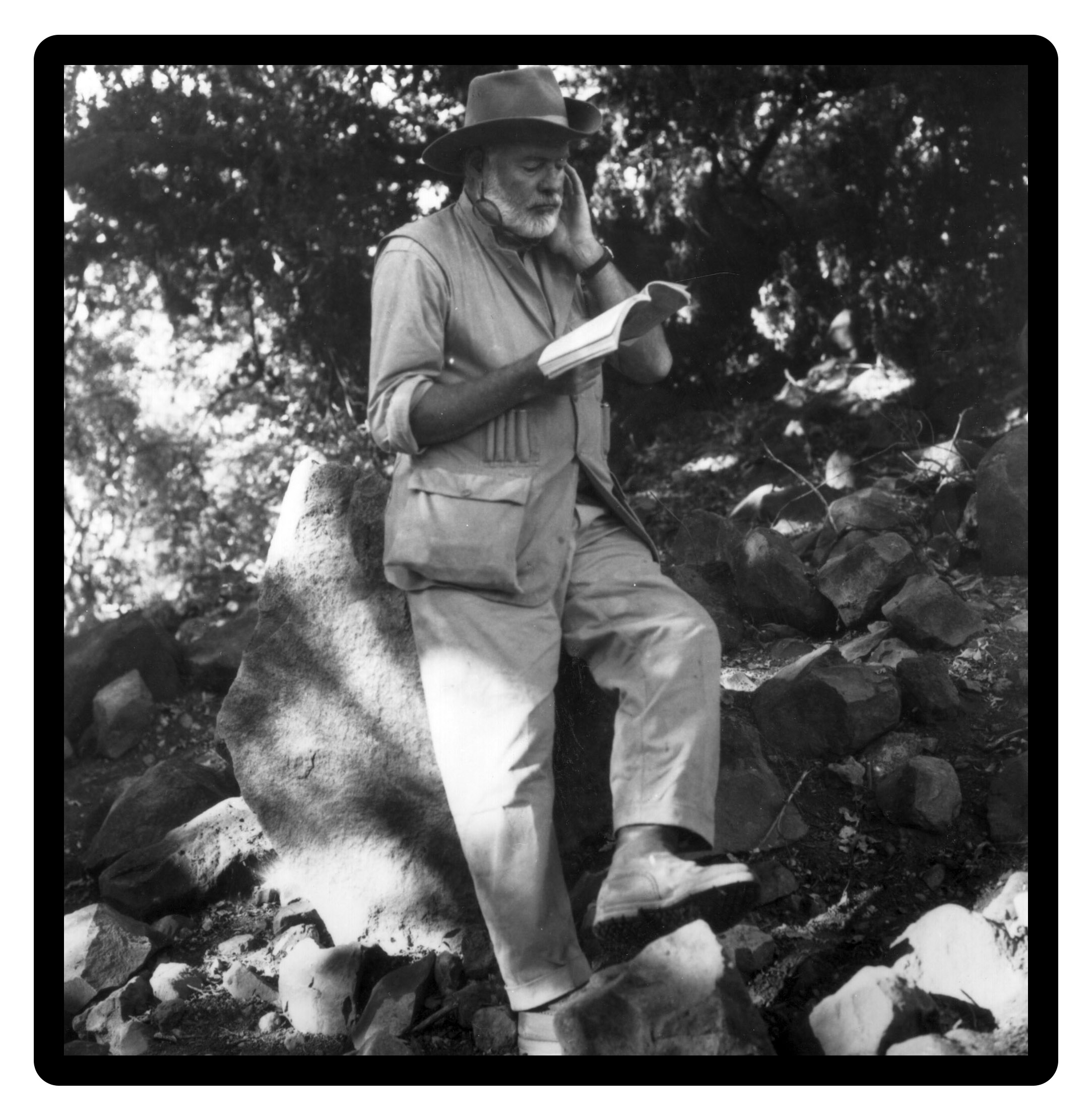
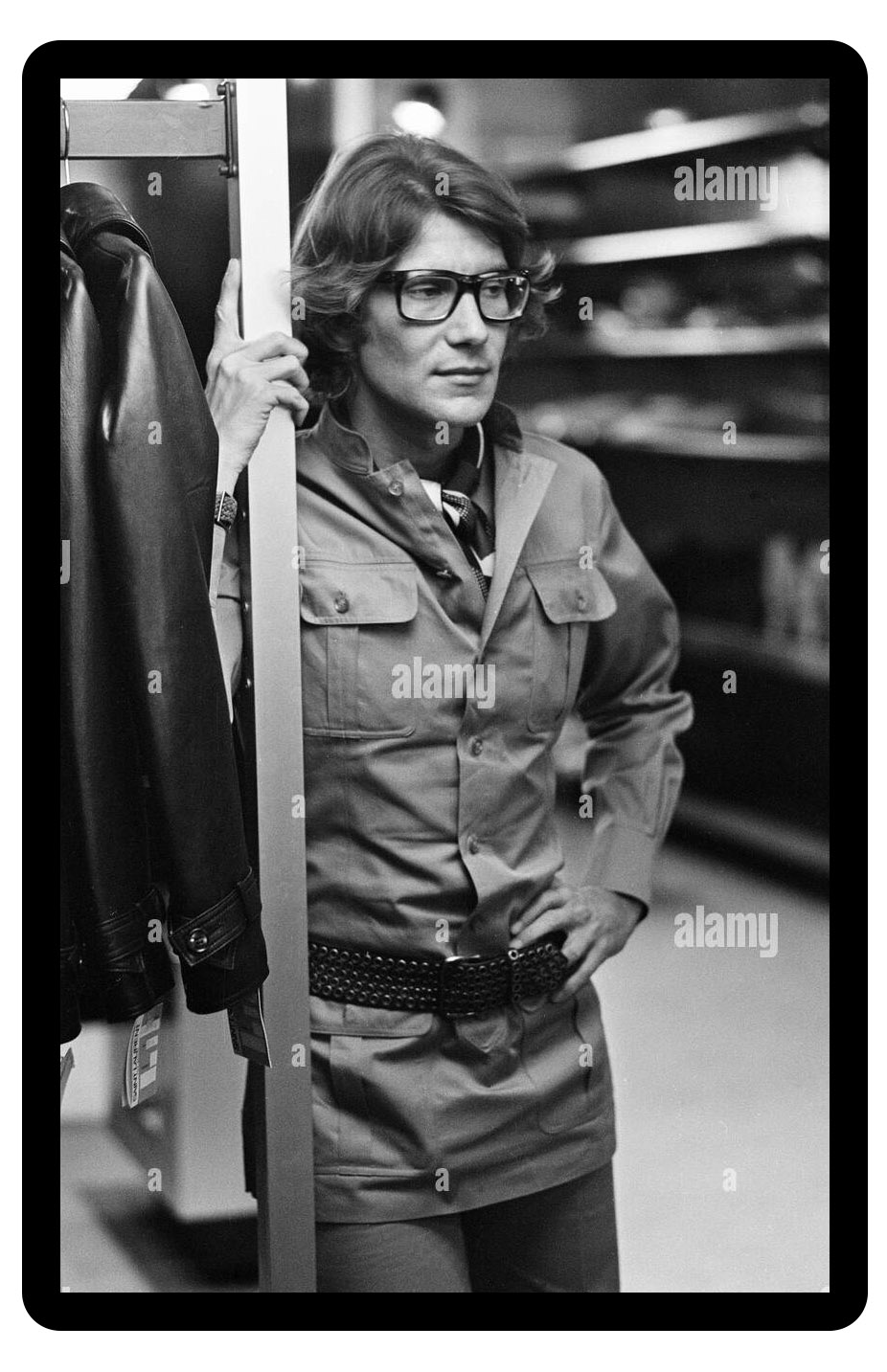
    It seems like the jacket very much stayed true to its military roots until the late 1960s, when Yves Saint Laurent introduced it in a runway context for ladies. This time with a longer, slimmer cut, and a more exaggerated point collar. Subsequently a precedent was set, as the garment became imbued with certain sense of louche glamour.
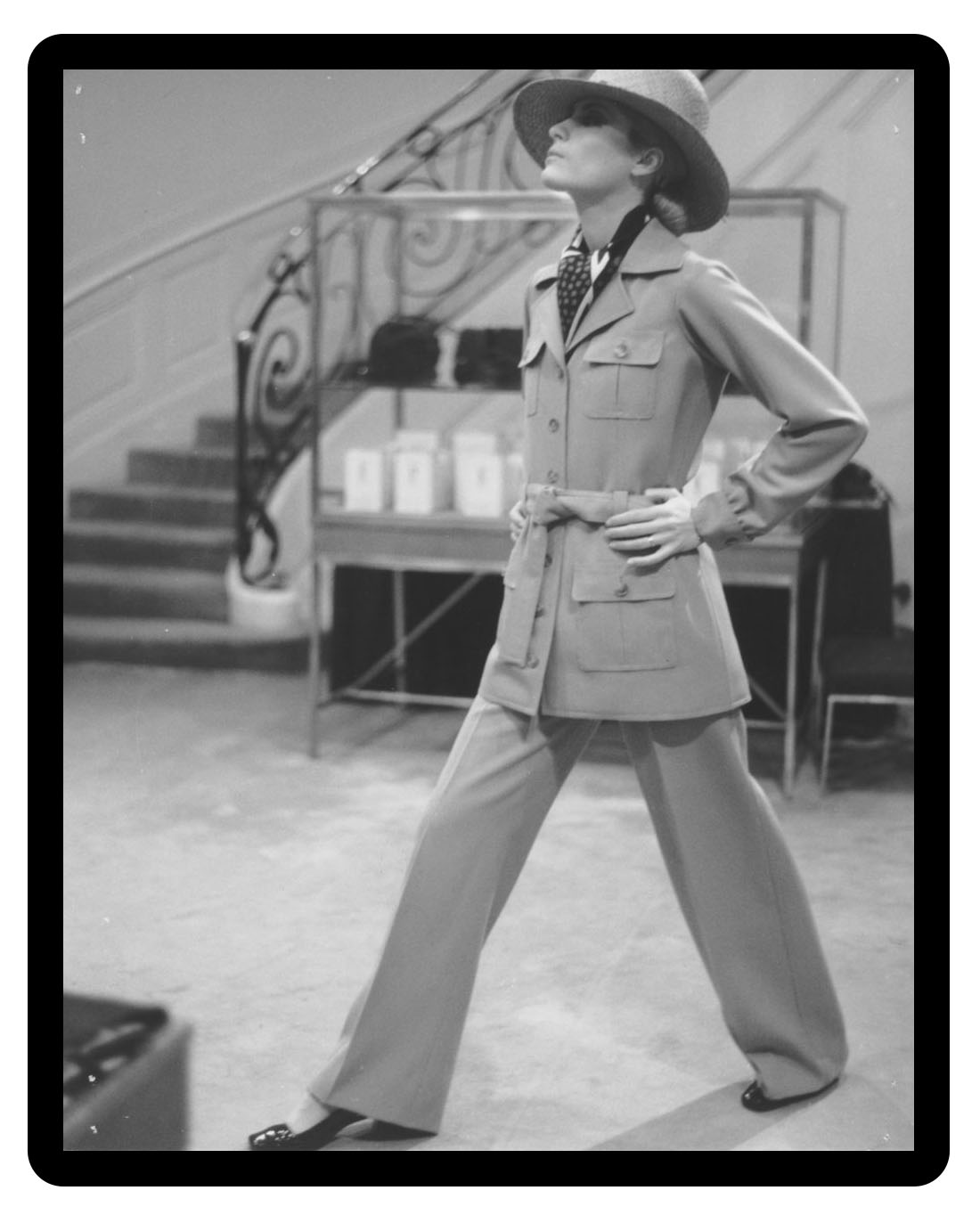
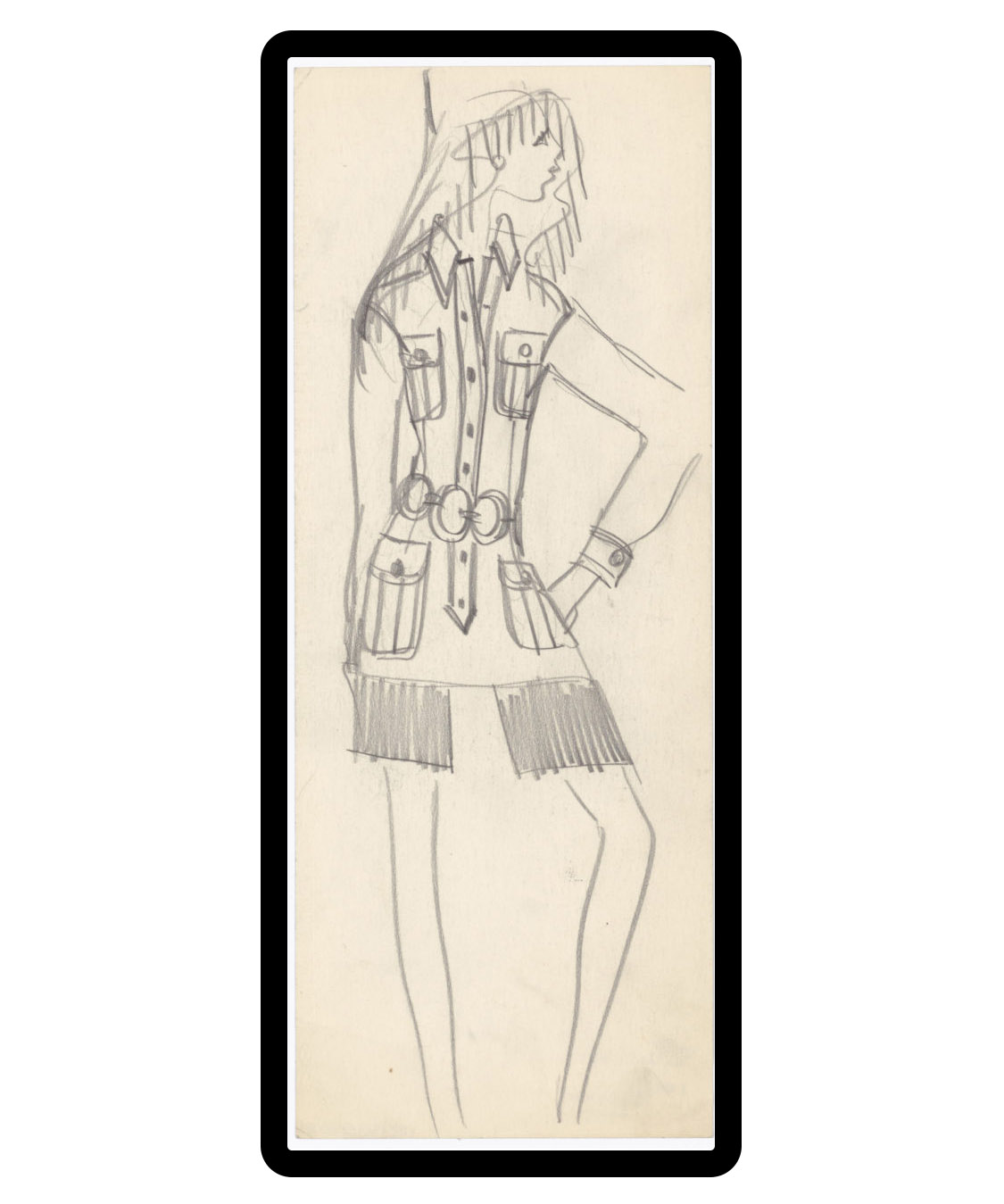
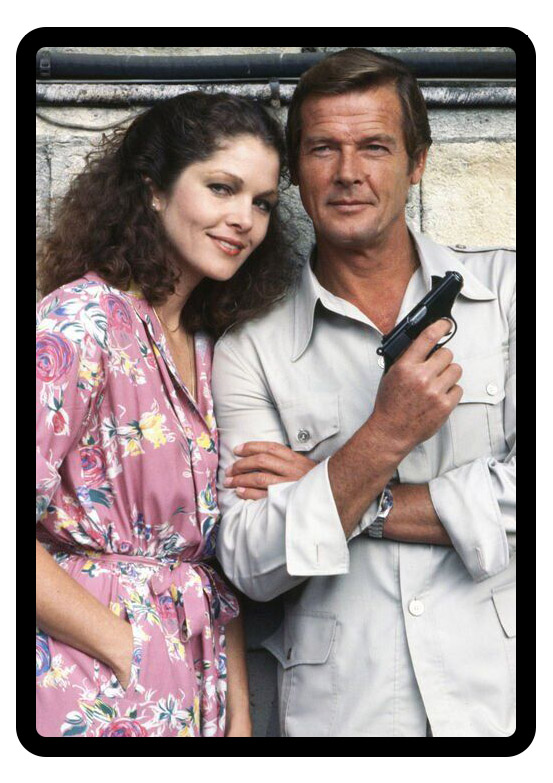
    And, In the 1970s, the designs really began to change, with examples becoming more streamlined and re-interpreted in a ‘modernist’ style. Nowhere is this better displayed, than in the versions worn by Roger Moore in the Bond films of this decade:


    Unfortunately though, the 1970s was also the decade in which synthetic fabrics were reaching the height of their popularity, and many cheap and nasty ‘Safari Suits’ in Polyester were made to cash in on the trend. Hence forth, the reputation of the Safari jacket would be sullied, consequently being resigned to the ‘Stuffy’ pile. And although brands like Ralph Lauren would continue to see the romance in them (Polo recreations of an 80s or 90s vintage are some of the best actually), from this point on it seems as though the Safari Jacket ‘moment’ was over.

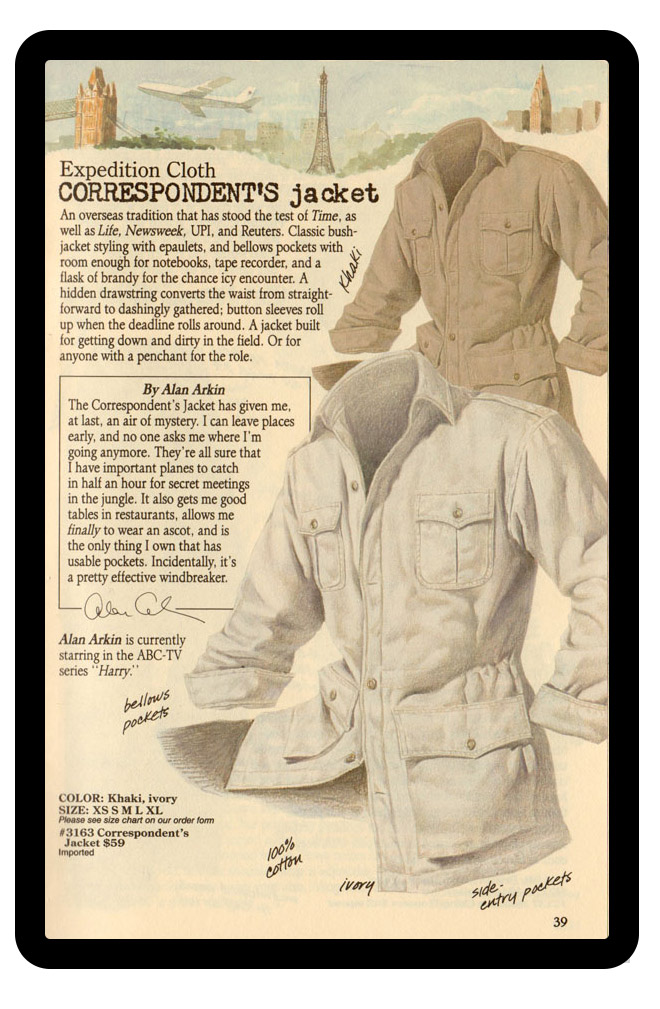
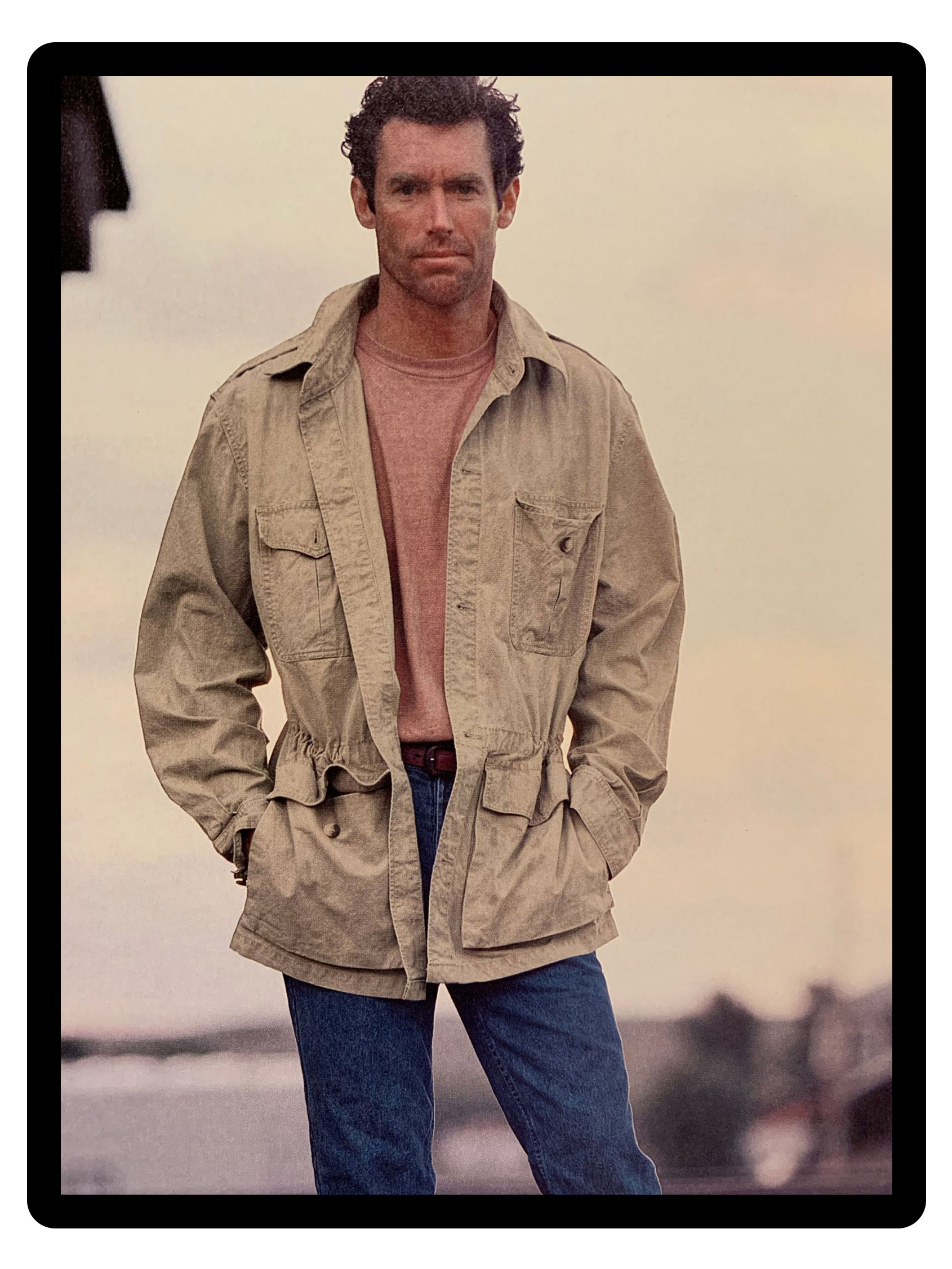
    For the sartorial connoisseur however, I think the lustre of the garment never really went away. And there are many brands today that cater to the modern gent who finds himself in need of one. When setting out to purchase one however, it is important to realise that there are essentially two categories of Safari jacket, which I have dubbed the ‘Rugged’ and the ‘Elegant’. As you would expect, the rugged safari jacket is one that stays close to the Military inspired source material, and as such comes made up in hard wearing cotton twills, in neutral khaki or olive shades. These pair well with faded old jeans or chinos, casual shirts, and desert boots (perhaps a classic German Army Trainer would work also for a more sporty look). It’s an outfit you can imagine a journalist or photographer abroad wearing. Banana Republic in their 1980s golden era even named their version after this phenomena. They dubbed it ‘The Correspondent’:
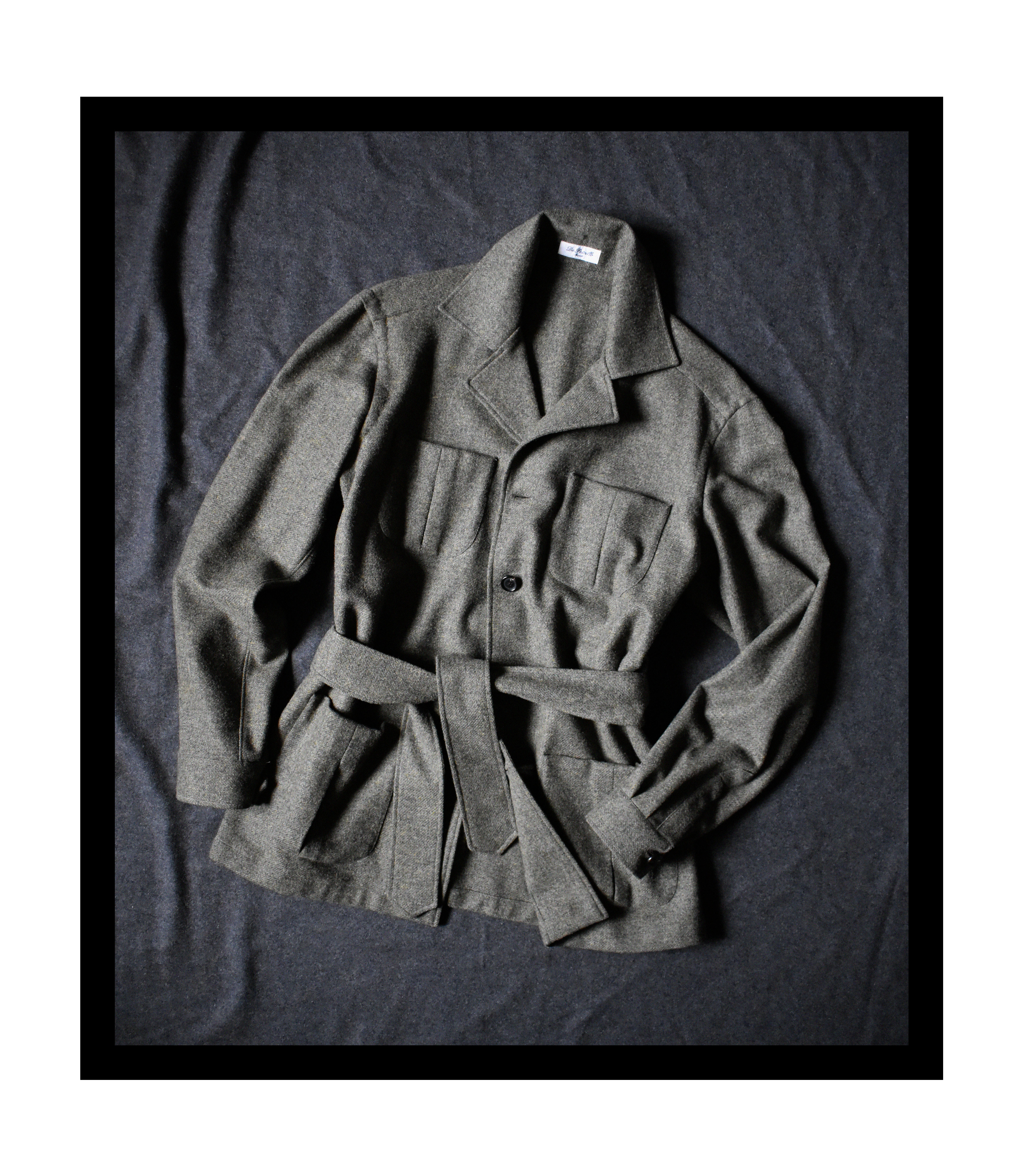
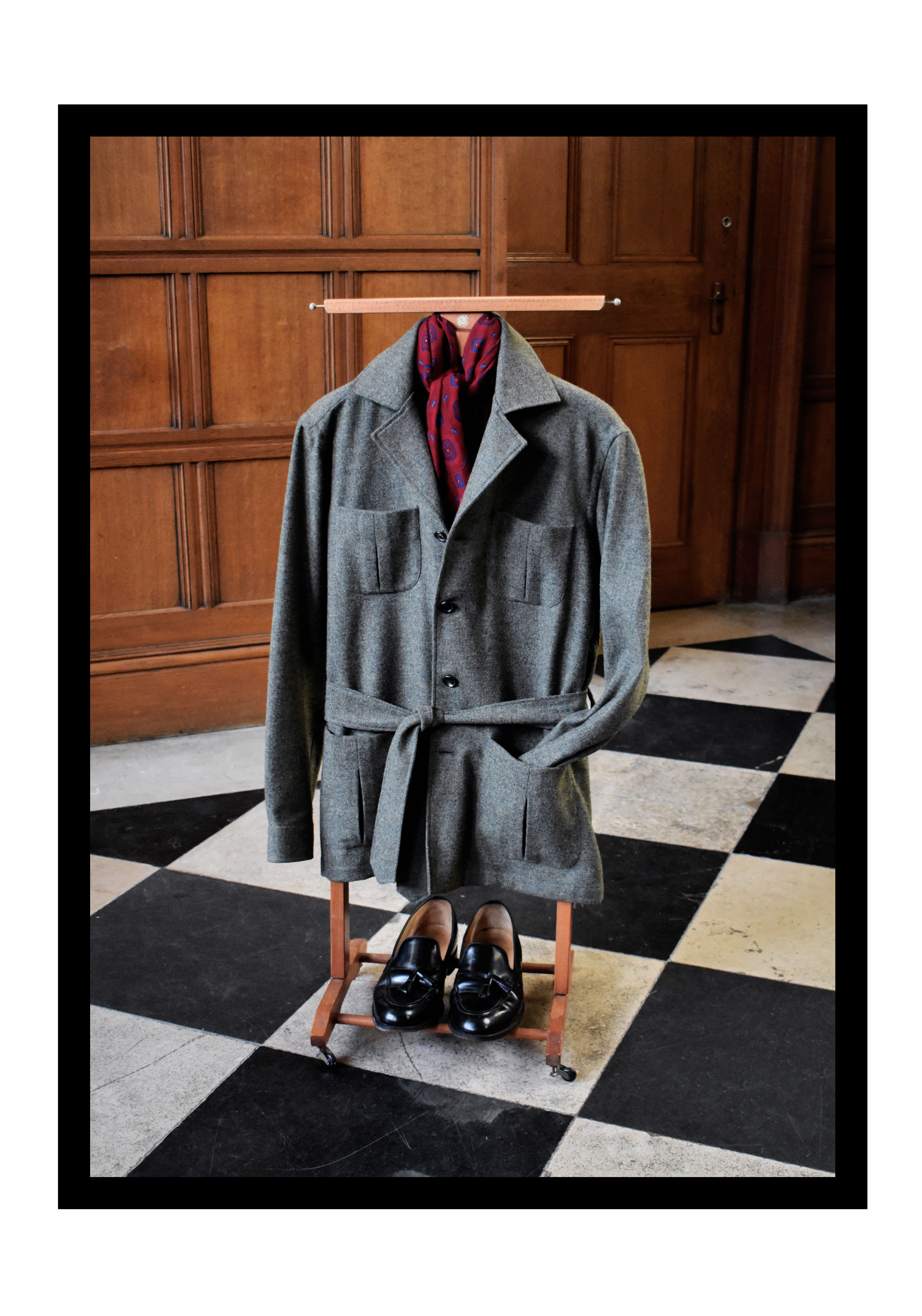
    However, for those who wish to find a safari jacket that compliments their tailored trousers and fine gauge knitwear, I would recommend an ‘Elegant’ safari jacket. This variety is best exemplified by the Italian ‘Sahariana’ styles that Neapolitan tailors are known for. Stylistically they seem more inspired by 1970s patterns, and come with simpler pocket designs and sharp collars that sit a bit more flush on the shoulders. If a belt is present, it will be a very basic one that ties around the waist, as opposed to having a buckle system. I also find that some are cut a bit shorter, with the idea being that one wears them with a higher waisted trouser. The goal is to maintain the more practical elements of the original patterns, whilst upping the refinement in terms of fabric and finishing. The result is something that is very relaxed and cosy, yet highly presentable. In this regard, an Elegant safari jacket is almost akin to a dressing gown or smoking jacket (you really just feel at home in one!).

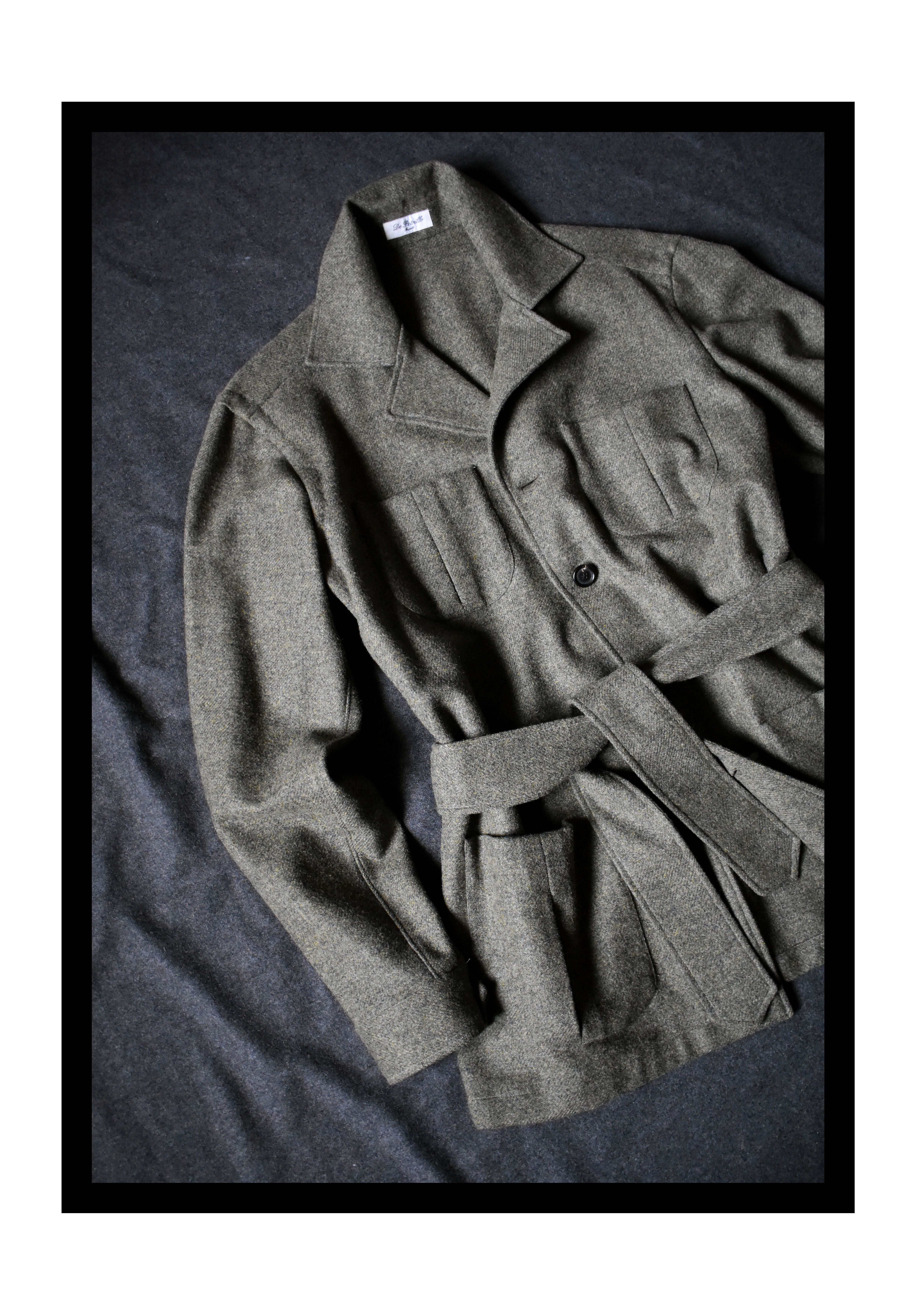
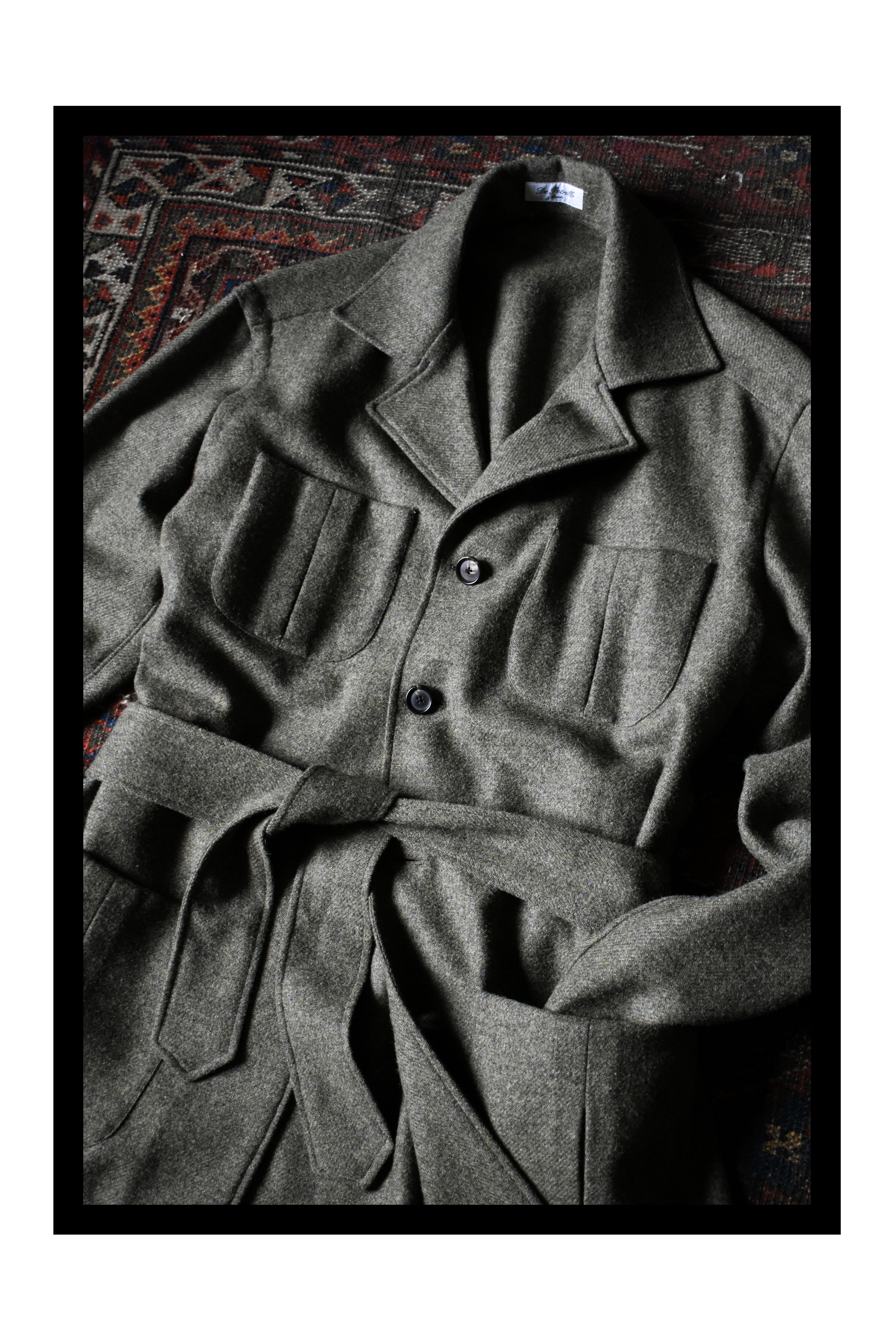
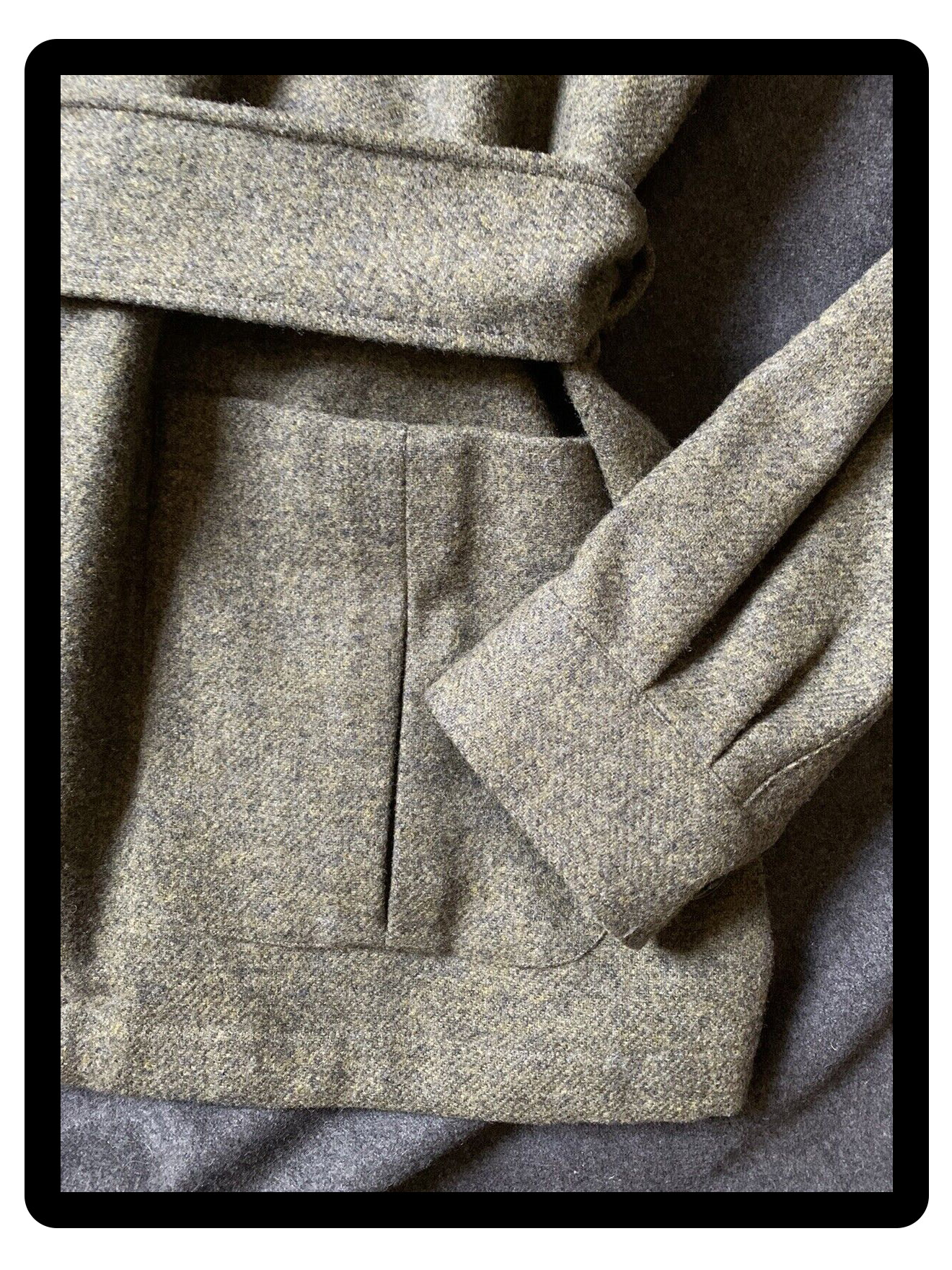
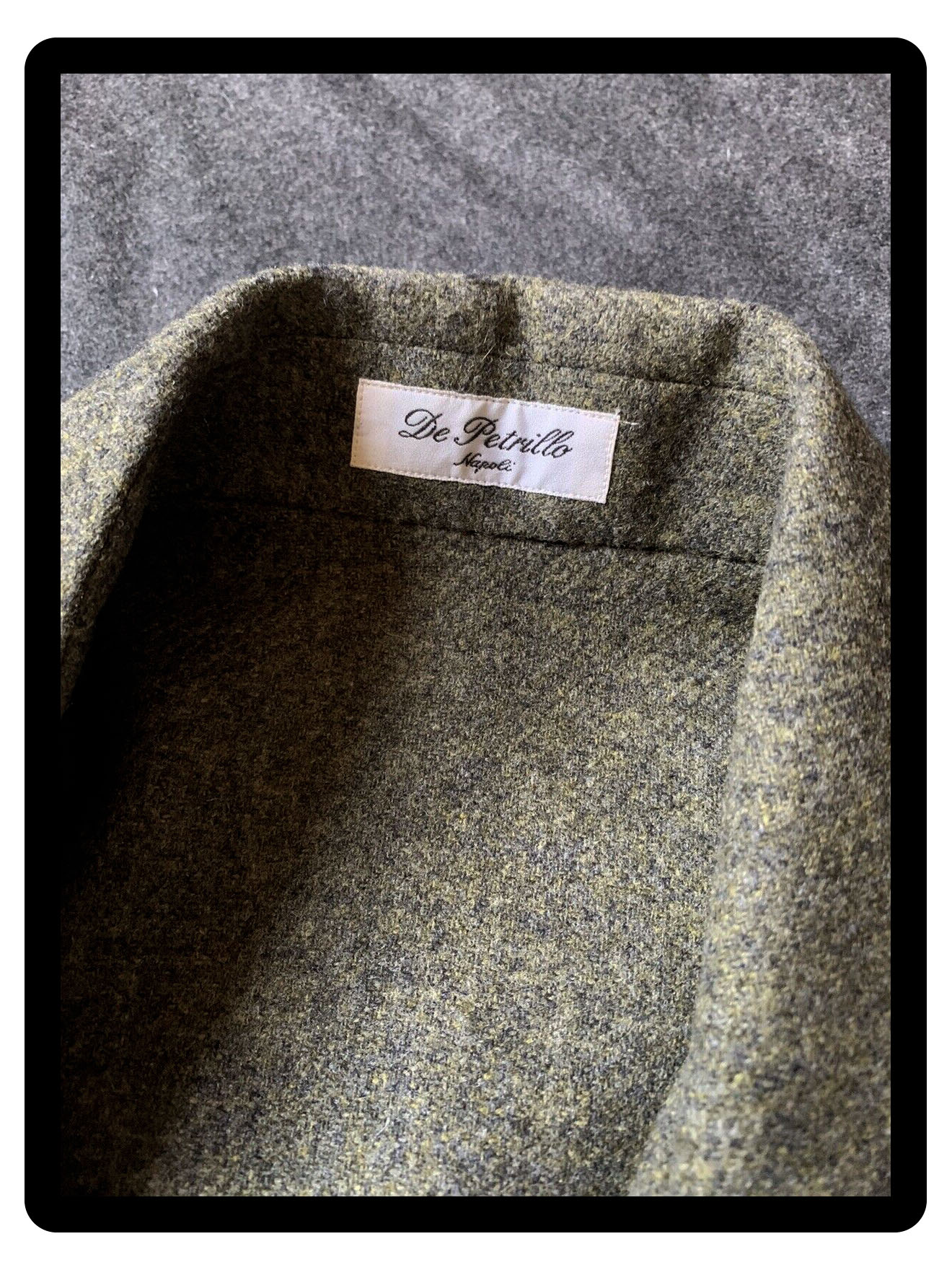
    It is a philosophy of comfort and style that certainly comes across in this gorgeous piece I am spotlighting here today. Crafted by the magnificent De Petrillo, this one features four open front pockets, each with pleat detail and cotton lining for added comfort. A generous collar is present, and a belt which allows the wearer to cinch in the waist for a classic silhouette. The cloth it comes made up in is also rather exquisite. A Grey Woollen twill that has these very characterful mossy Green inflections, almost tweed like. This is a great example of what the Italians do best: luxury takes on quintessentially British patterns. Surely worthy of the title ‘Elegant’…
    Available to purchase in the Sartorium here
  • On The Style Of Yukio Mishima

    Aug 17th, 2024

    Writers have always held a special place in society. Be they the bard, whose words are said to channel the collective consciousness of their people. Or be they an individual stylist, the type of writer who delves into the murky depths of their psyche, and plucks fantasy from within. Then there are writers who blend both tendencies, weaving their understanding of a broader folkish sensibility with their own interpersonal experience, often using forms of auto-fiction to do so. One such master of this kind of synthesis was the 20th century figure Yukio Mishima, whose works function as a window into both his own troubled mind and the Japanese spirit. The themes of his novels are often heavy, with his debut ‘Confessions Of A Mask’, containing complicated psychosexual meanderings and aesthetic musings, wrapped up in a tale of adolescent ennui. Then on to one of his final works in ‘Runaway Horses’, we are told the story of a group of young men spurned by a form of romantic nationalism and a desire to reinstate the glory of the emperor. It culminates in a plot to assassinate state officials, and is representative of Mishima’s penchant for glorifying grand gestures involving death, destruction and rebirth.

    What made Mishima truly extraordinary however, was his commitment to his own life as a work of art and as a lasting tribute to his philosophy of ‘Sun And Steel’. As illustrated in his transformation from an effete, sickly writer, and into a bodybuilding star of international renown, who would go on to cultivate his own private militia known as the ‘Tatenokai’. In November 1970, Mishima and the Tatenokai attempted to instigate a coup at a Tokyo army base, but it was an act that ended in failure. This set the stage for Mishima’s final, and perhaps most powerful statement: ritual suicide via seppuku.

    Now, whether one looks at the life of Mishima as an extreme postmodern experiment in celebrity, or as a tribute to the cult of the samurai and a commitment to patriotic ideals, the fact remains that his visual legacy is a powerful one. Indeed, in many respects the photographs we have of Mishima summarise the man more succinctly than his novels ever could. Today his image finds favour in ‘vitalist’ circles online, and he has become a cult like figure for ‘sensitive young men’ and masculinity influencers alike. But whenever I have brought his name up to Japanese acquaintances in London, I am met with a sort of puzzlement, a confused laughter or even a slight disdain. It is clear that contemporary opinion of him in Japan is a mixed bag, and he remains somewhat of a mystery within even his own nation. None the less, the Mishima character continues to invite analysis and inquiry from across the spectrum. Today I wish to look at an element of his life that has not been focused on as much: his wardrobe.

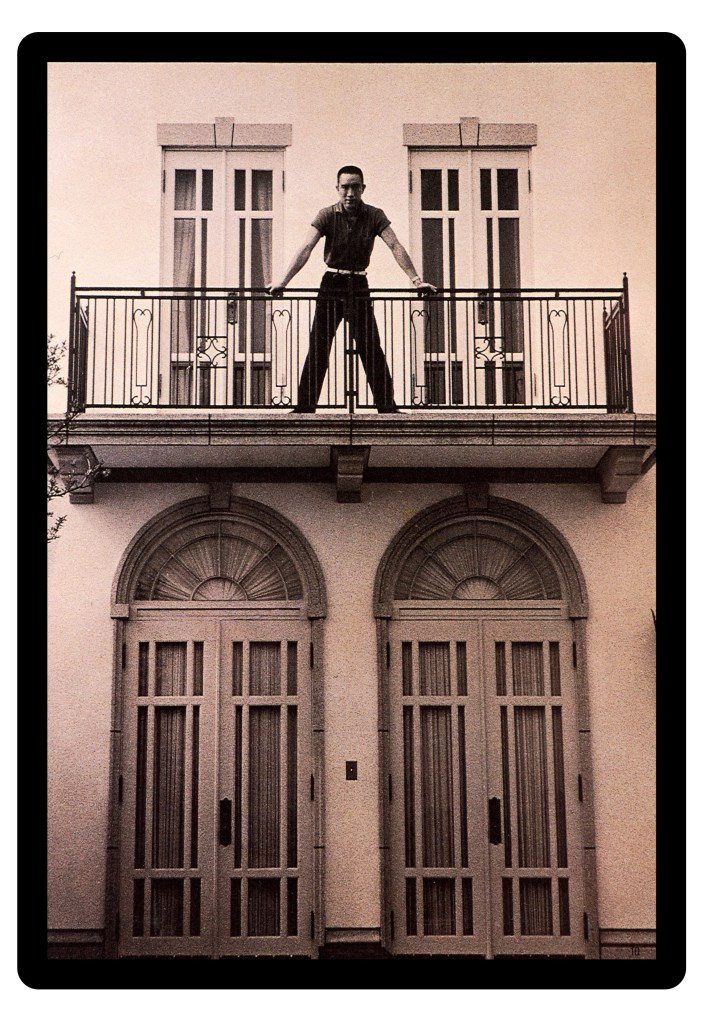
    The sartorial choices of a writer can often tend toward the eccentric, due to the levels of individuality and idiosyncrasy such a profession can lend to a person. It was Oscar Wilde who provided a blueprint for the modern archetype of the ‘writer as dandy’, and was hugely influential for Mishima. But the influence of Wilde did not carry through to his fashion sense it seems, as upon reviewing two decades of photographs of him, one sees a rather restrained and refined personal style. A style that is of a clean and somewhat modernist variety, with some noticeable flourishes in garment choice that I will delve into here.

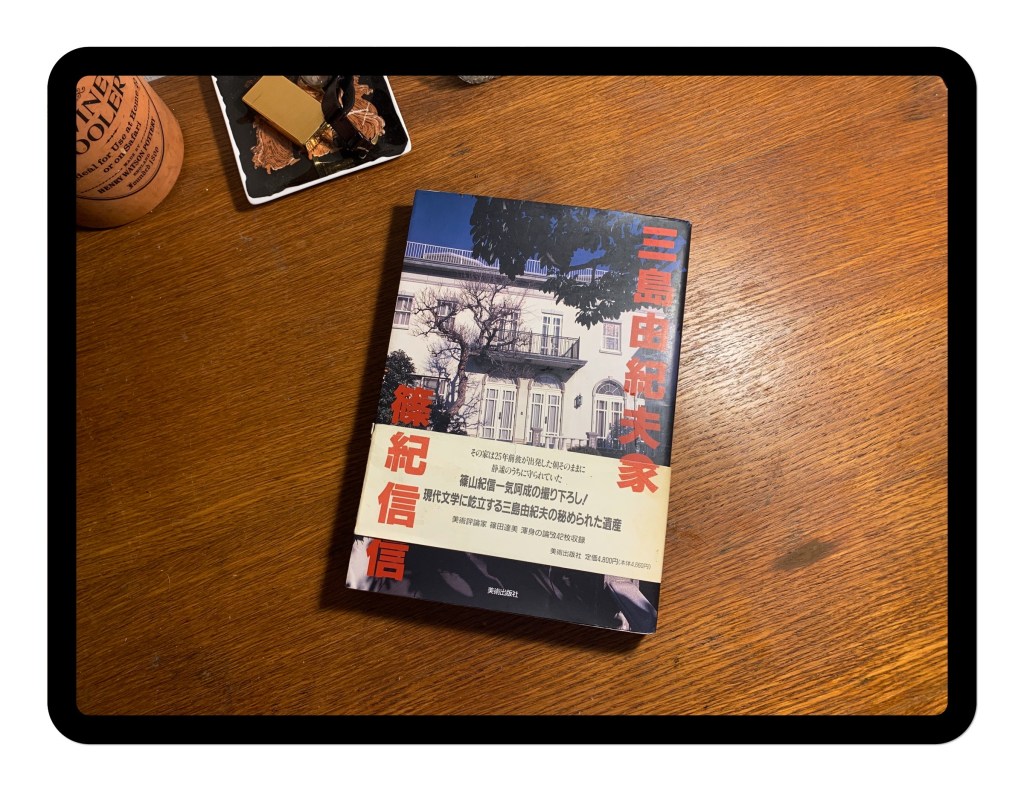
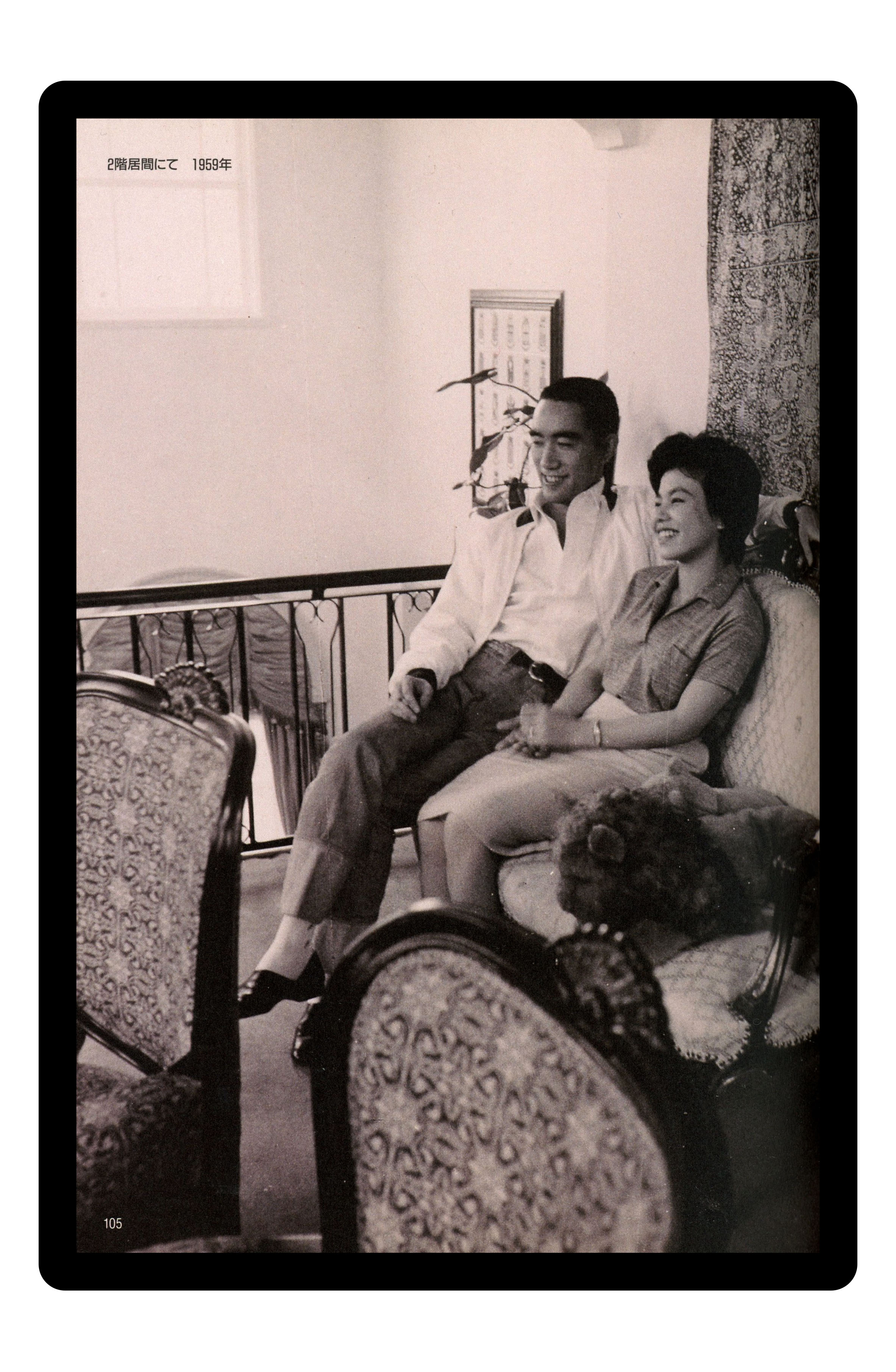
    There are a good amount of photographs of Mishima online, but alot of them seem to centre around his more bombastic moments, either in his Tatenokai uniform or in some state of nudity, brandishing swords and such. In light of this I thought I would look for a more curated resource to glean a potential sartorial analysis. I arrived upon the book ‘The House Of Yukio Mishima’ which, as the title would suggest, is about the man’s house. It was made only for the Japanese market, but was well worth my importing it. With a series of gorgeous shots taken by the master of naturalism Kishin Shinoyama, we are provided with an intimate tour.

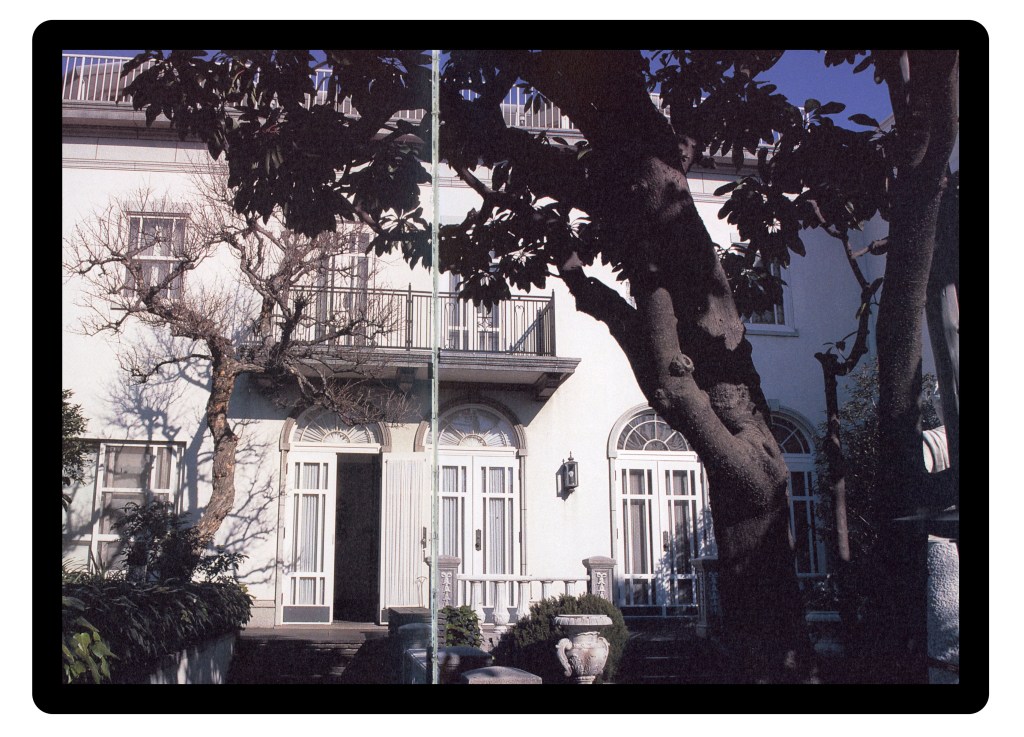
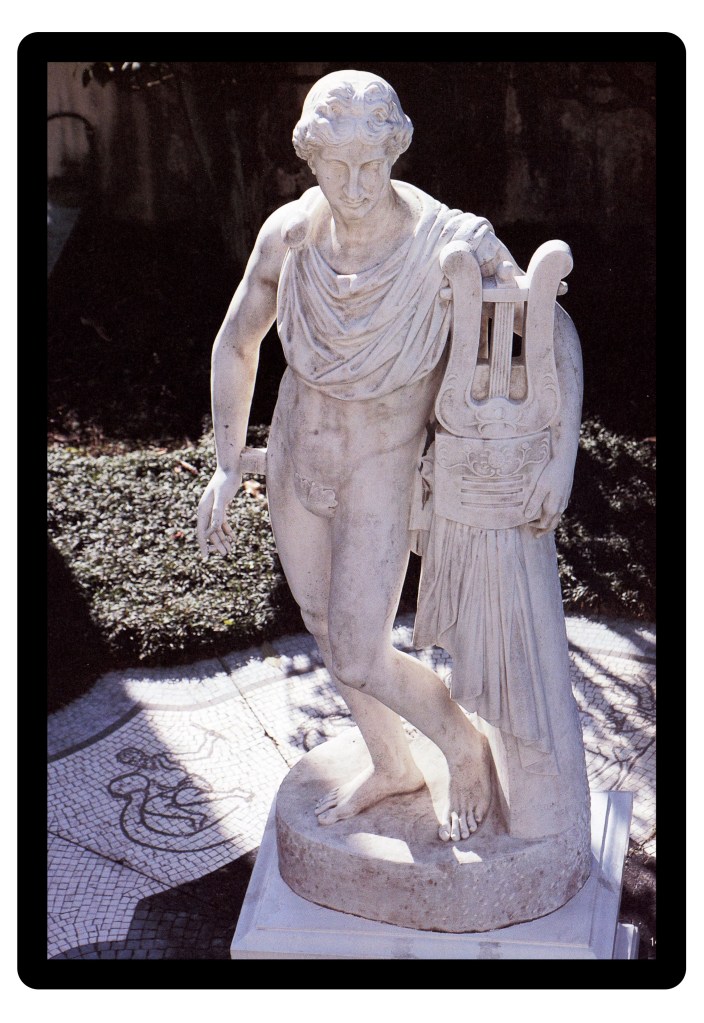
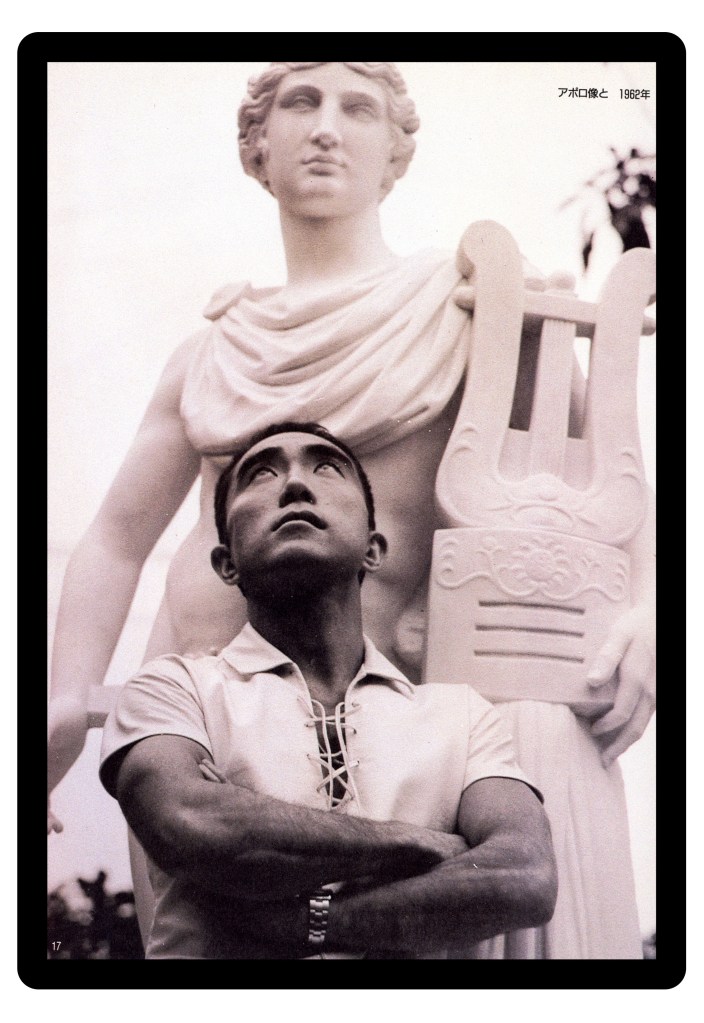
    The house’s facade sets the tone for a classically inclined man, being made up in an architectural vernacular akin to a variety of French Neo-Classicism or perhaps a Regency Period townhouse. There is a small front garden, and in it stands a statue of the sun god Apollo, representative of Mishima’s solar world view. In keeping with the scale of building in Tokyo, the structure is rather compact, featuring humble living and dining areas decorated with pared back Baroque furnishings and immaculately curated antiques and ephemera, acquired on trips to Europe. There is a sizeable section of the book dedicated to Mishima’s study upstairs, and there are also some photos of an observatory style room with a uniquely designed rounded sofa.

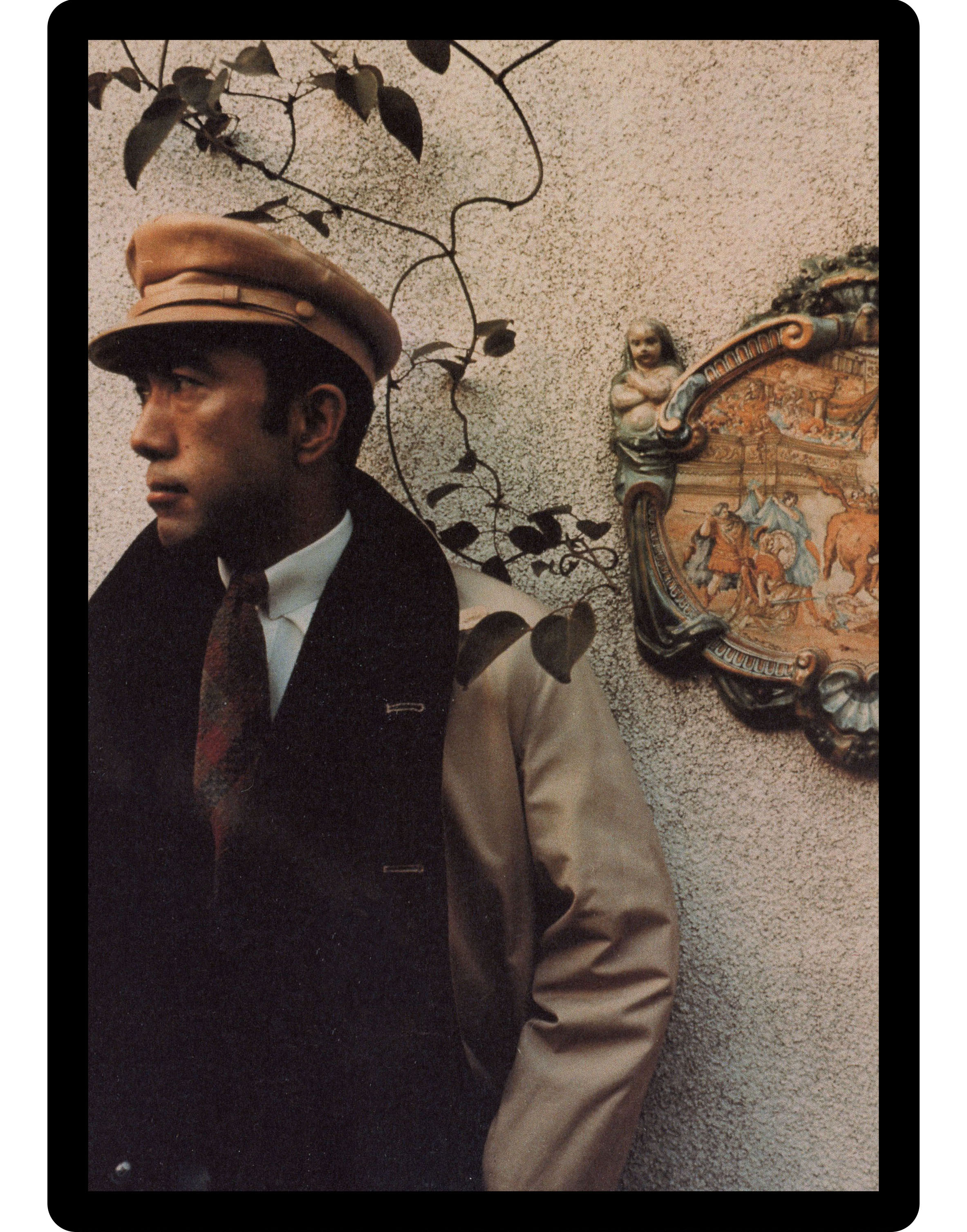
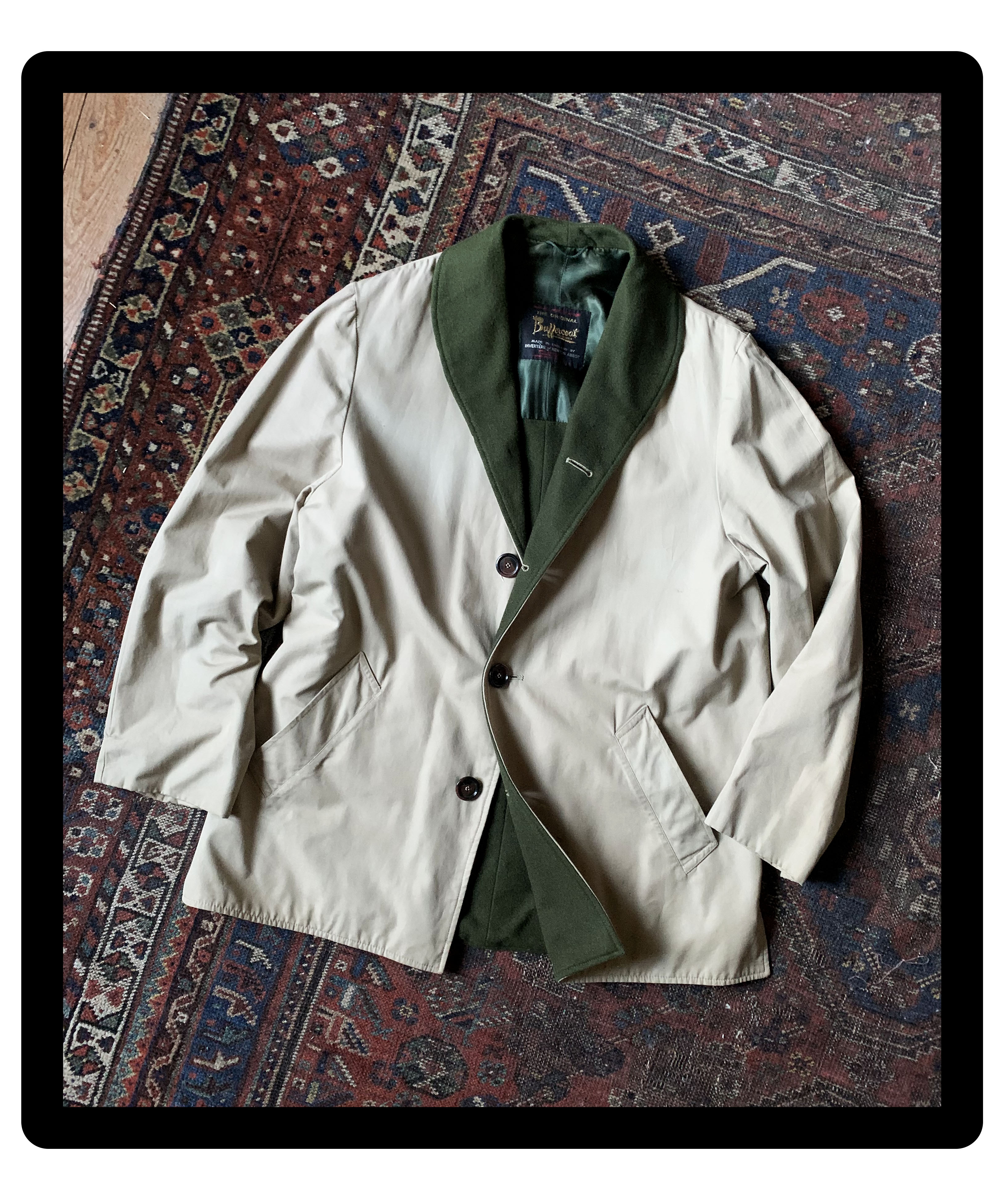
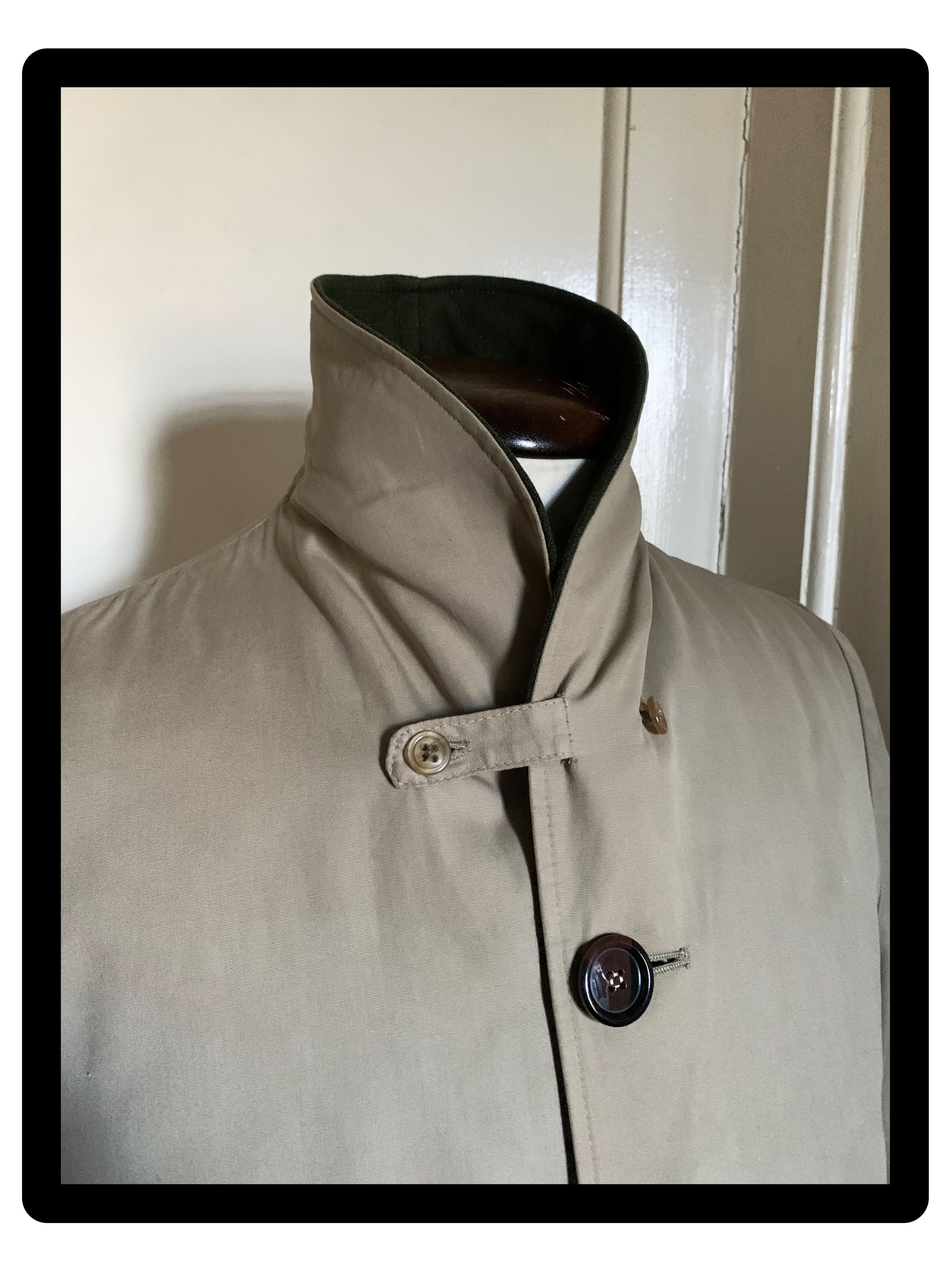
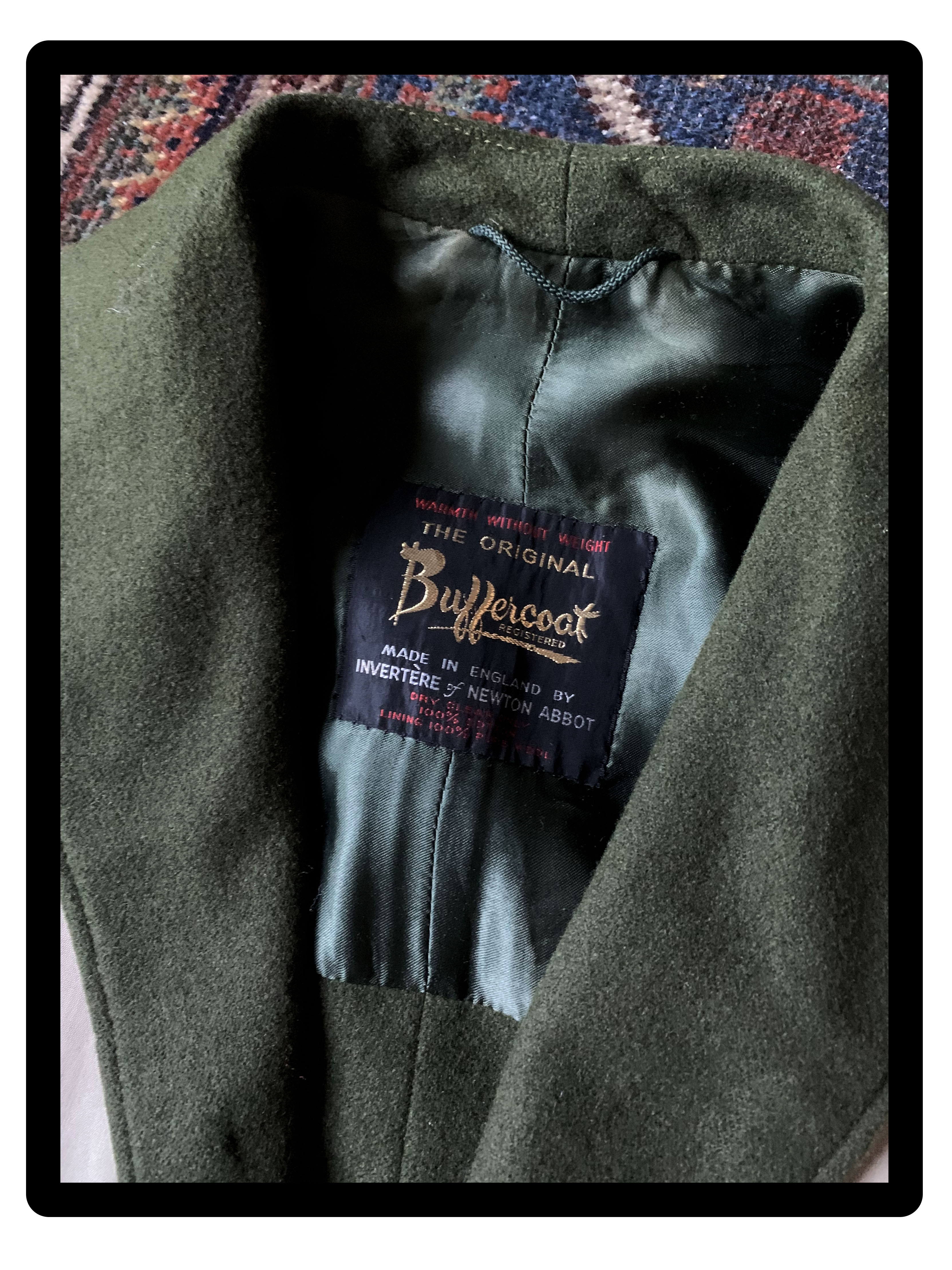
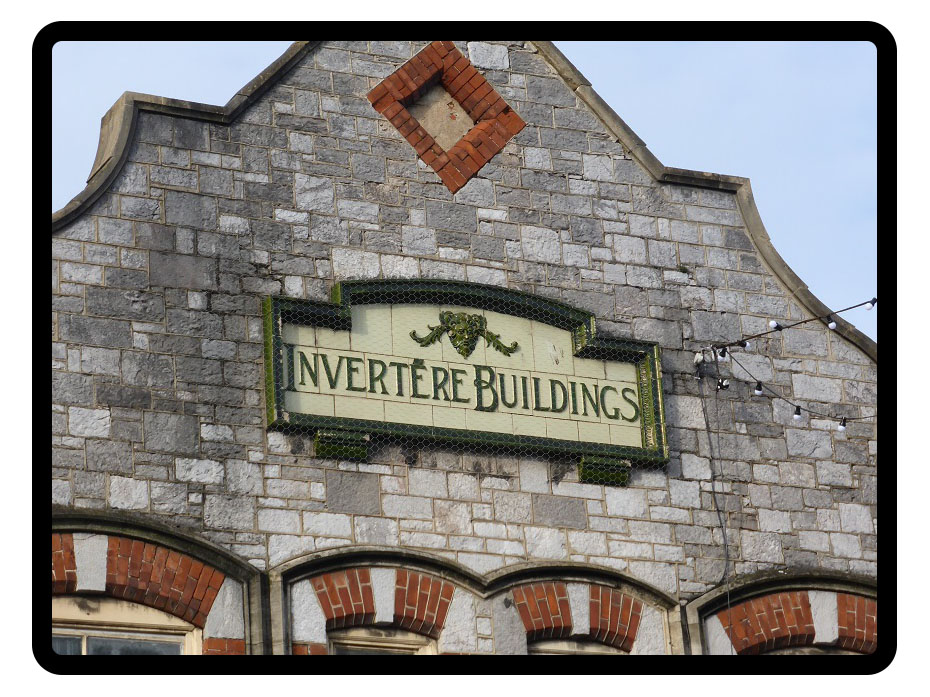
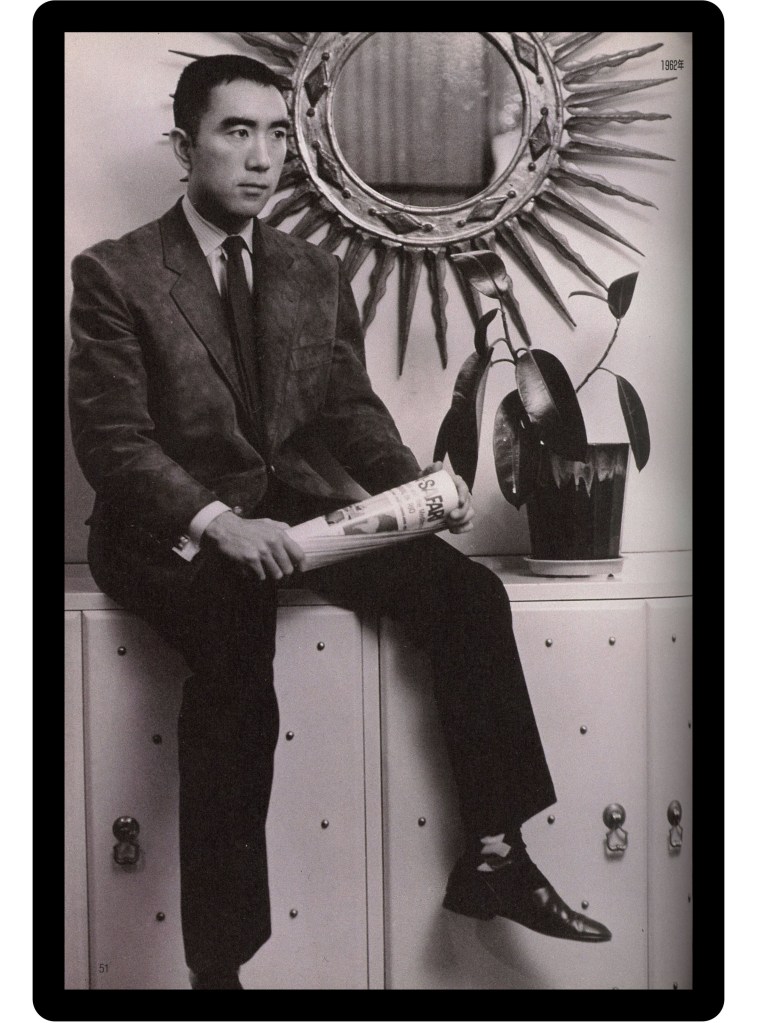
    Interspersed between the liminal portraits of the rooms are some choice shots of Mishima that display his taste in dress. I was particularly pleased to see an image of him wearing a style of jacket known as a ‘Buffercoat’. A rather esoteric example of English country wear, the Buffercoat is marked by its distinct shawl collar which can be flipped up and fastened via a tab in order to provide a ‘buffer’ against the wind. It almost certainly would have been made by the famous ‘Invertere Of Newton Abbot’, who were a British coat manufacturer that produced under their own label, and also for Daks. Both brands were once owned by the department store Simpsons Of Piccadilly, so it is likely that Mishima would have picked up his one on a trip to London.

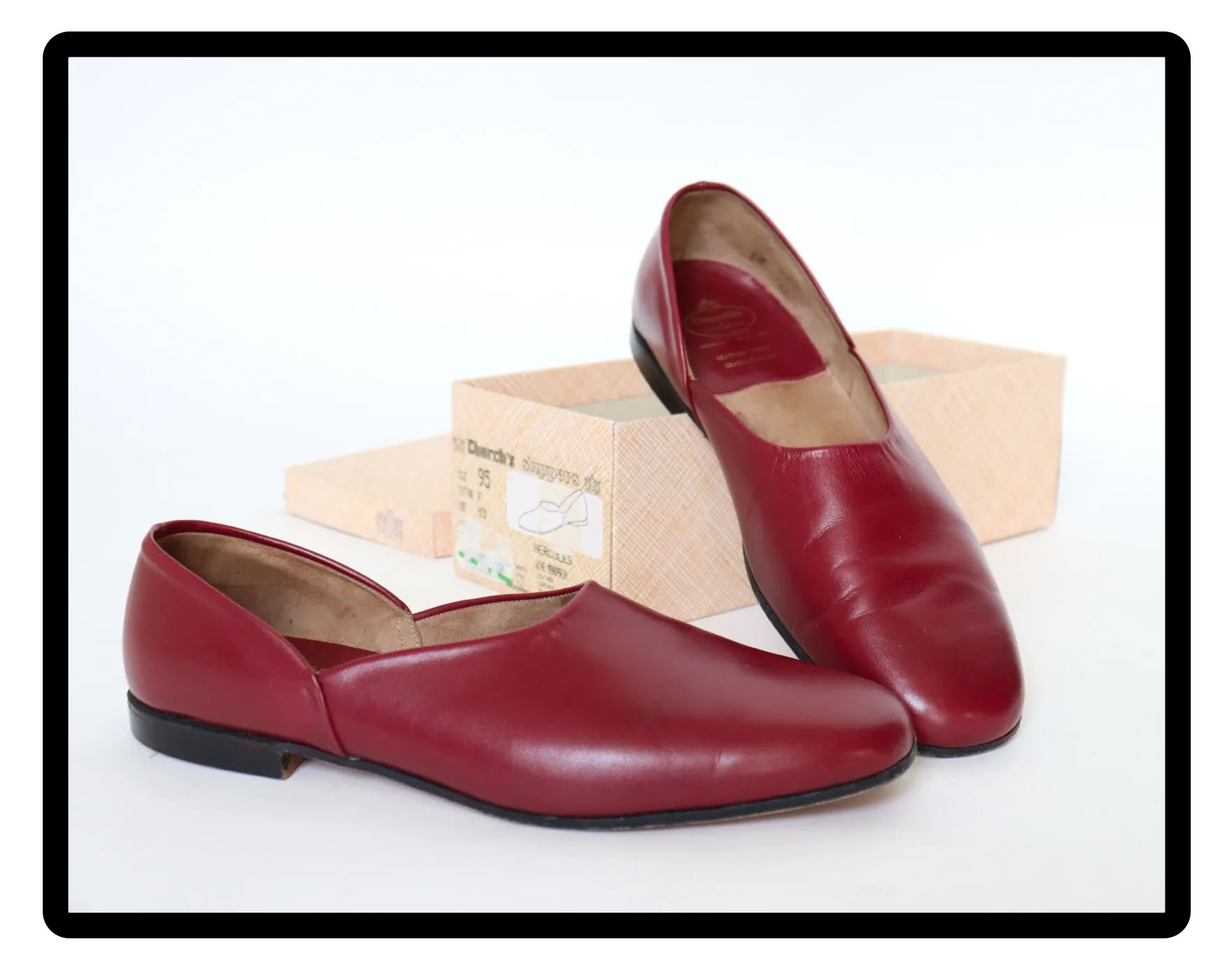
    Another interesting choice is found in Mishima’s footwear selection. Specifically he appeared to enjoy a Grecian style leather slipper, and is shown wearing his pair with Argyle socks. This design of slipper is a great medium between the very casual backless ‘mule’ slipper and the more formal Prince Albert. Church’s have always supplied all three of these styles, and I am inclined to believe Mishima would have acquired his from them. I associate this slipper with the type of gent who likes to spend long days in his study, perhaps reading up on matters of antiquity. The Grecian then was a perfect fit for a man like Mishima, who would have wanted to maintain a certain elegance when brushing up on his knowledge of Ancient Greece and Rome.

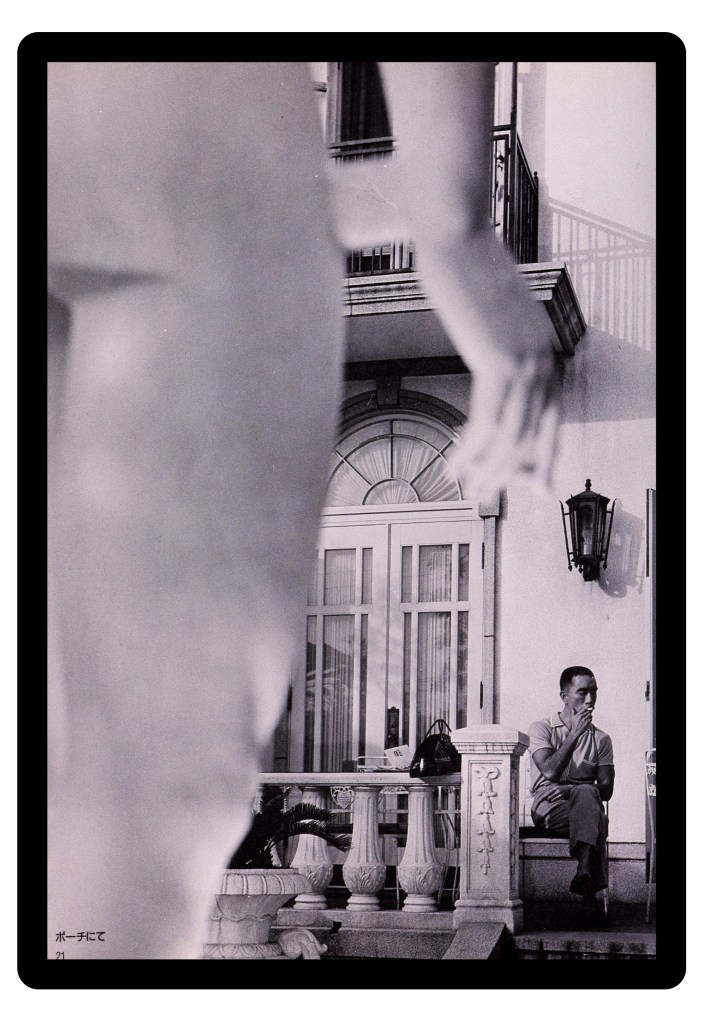
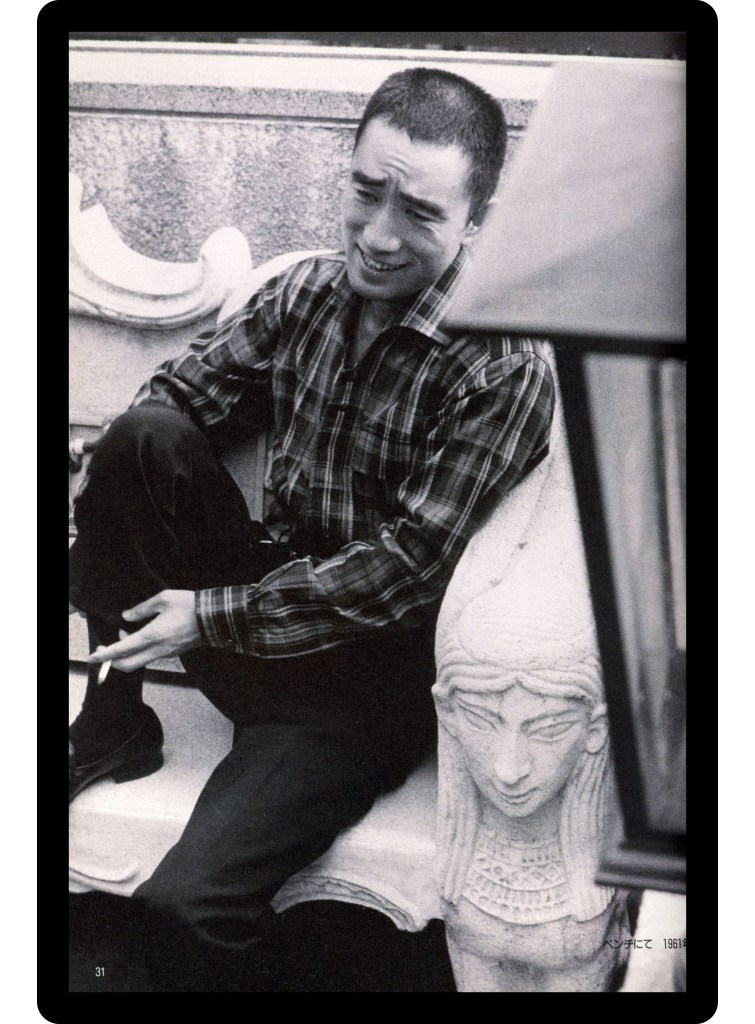
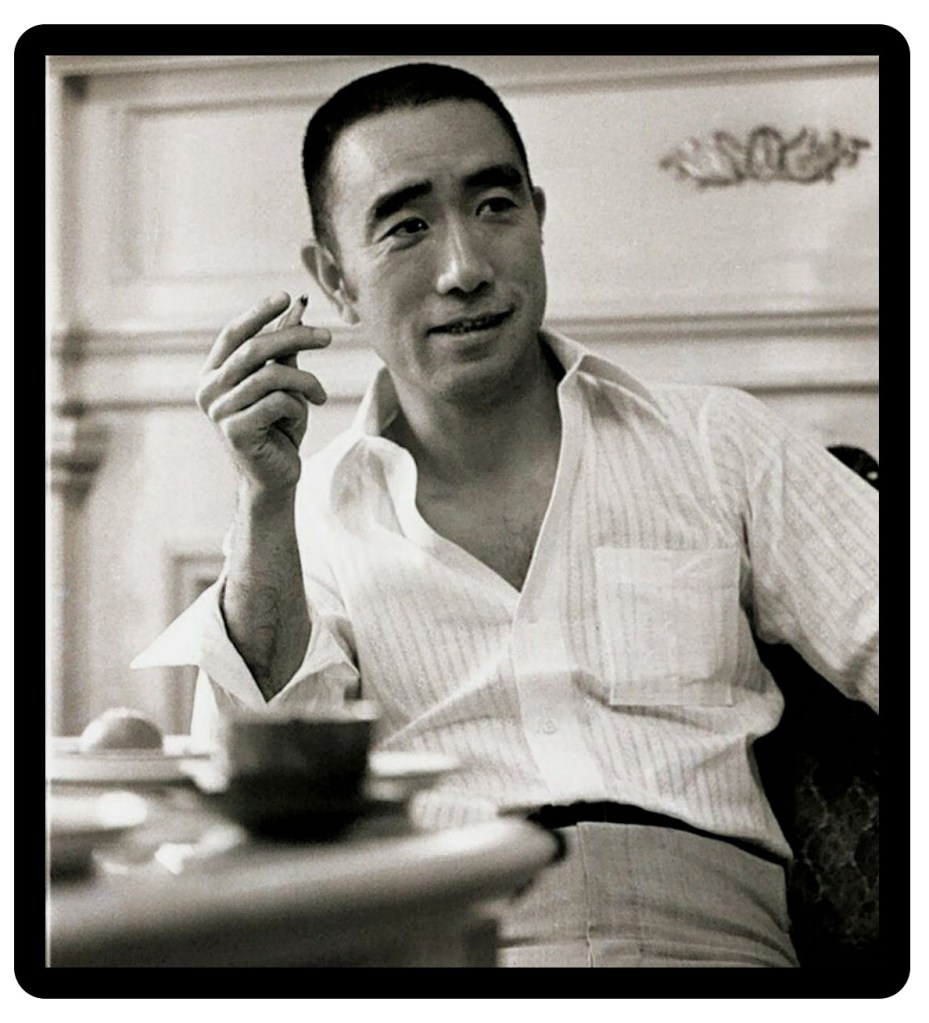
    In another moment we see Mishima enjoying a cigarette in a casual outfit consisting of a Madras cloth shirt, slacks and penny loafers. He seemed to lean into these Ivy informed looks a fair amount, as there are lots of other photos I’ve seen of him in odd tweed jackets and club stripe ties. It is not surprising that such inflections would find their way to Mishima during this time. Teruyoshi Hayashida’s seminal ‘Take Ivy’ book released in 1965, and featured candid shots of well dressed students on the campuses of Yale and Harvard that would leave a lasting impression on male fashion in Japan. Ivy is the kind of style that is very much open to individual interpretation, and many get it wrong, but here I think Mishima gets it right.
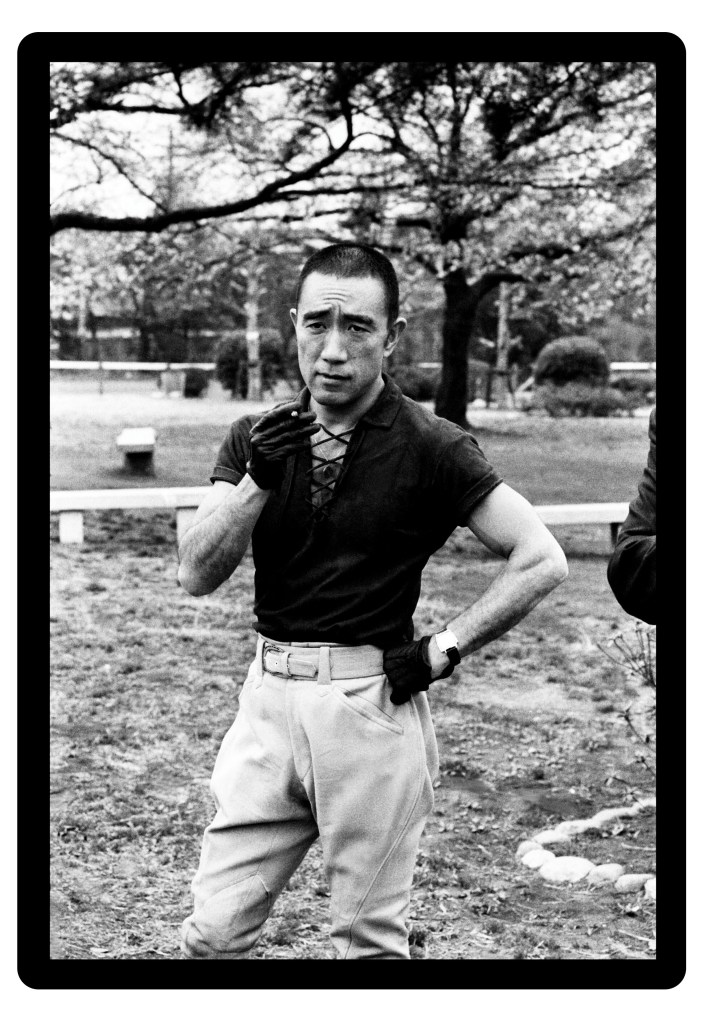
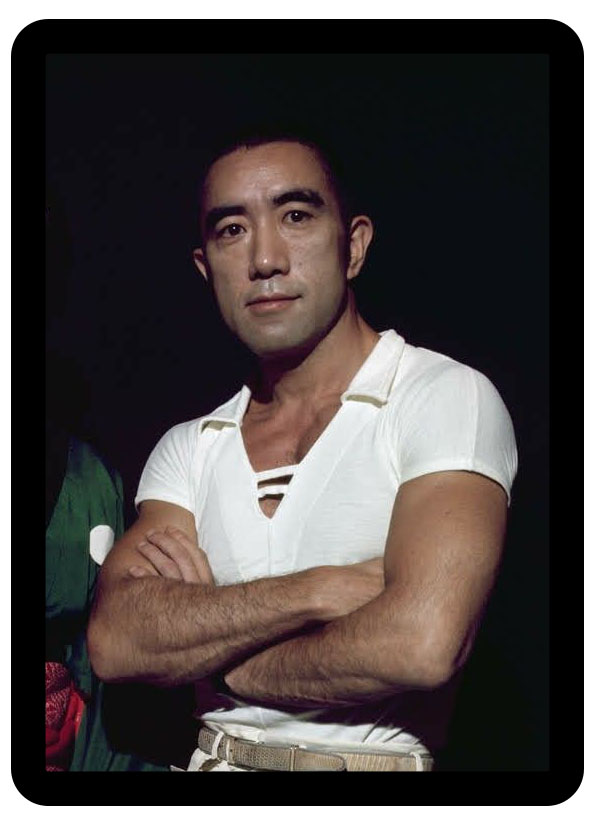
    One recurring item you see Mishima wearing throughout the book and in photos elsewhere are polo shirts. His were quite eccentric by today’s standards, and were indicative of a more experimental period of mid-century design. This was a time when a polo may have been marketed as a ‘sport shirt’ or something along those lines. In the 1950’s through to the 1970’s, there was a lot of experimentation with certain details on these kinds of shirts, which you can see reflected in the styles worn by Mishima. In the book he is shown wearing one that has a very unique lace up collar. I suspect this was a detail appropriated from old Rugby shirts, so seeing it on a more ‘regular’ polo shirt with its finer cotton construction is quite unique (I have included another photo of him in a Black version that was found outside of the book).

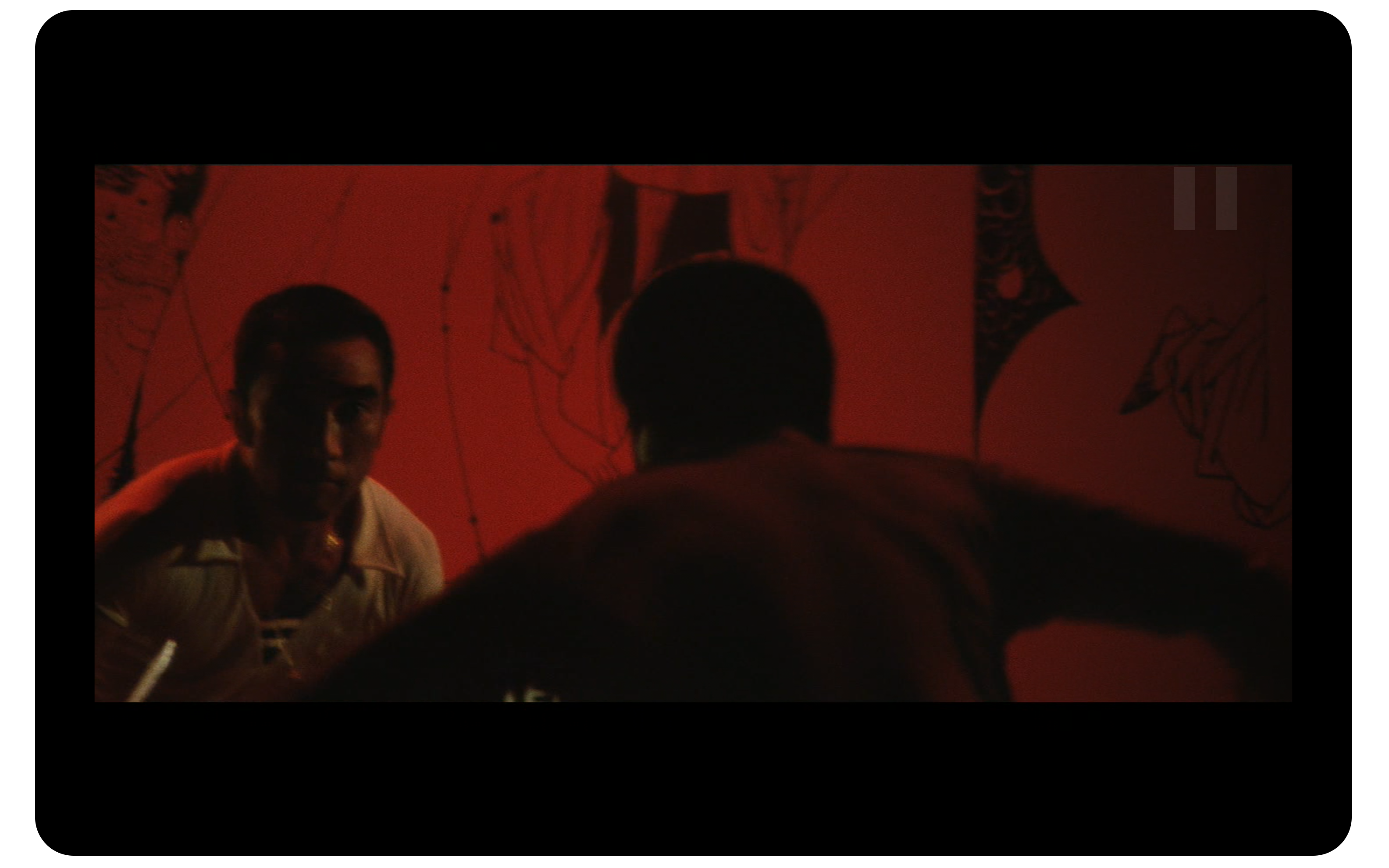
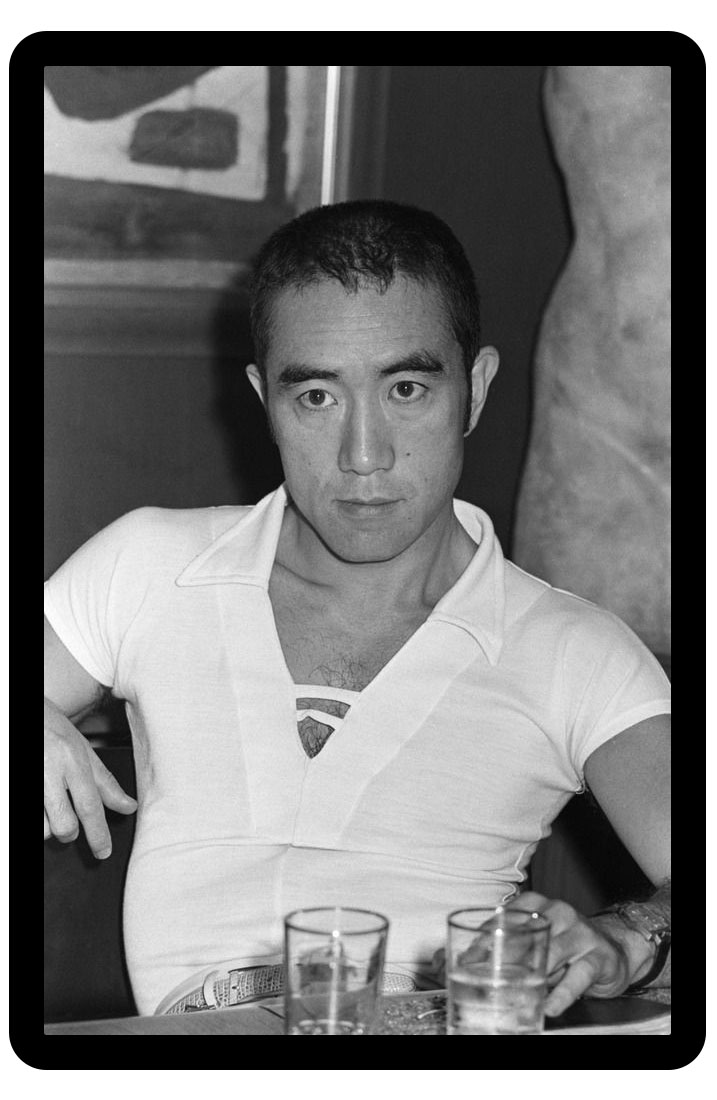
    I have seen him in other interesting polos, including one he wore for a brief appearance in the surrealist gangster film ‘Black Lizard’. The polo is made from what looks like a kind of semi-sheer white cotton, and has a buttonless deep V Neck, with two bands across the bottom of the opening. It is unlike anything else I have seen. The angles and lines are reminiscent of an Art Deco sensibility, with clean shapes that cut just right. These types of ‘modern’ designs would fade out after Ralph Lauren’s preppy polos became hegemonic in the 1980s. But there has been a renewed interest in these older, more obscure styles, with brands like Brycelands and Scott Fraser Collection revisiting them. Perhaps Mishima’s polos could provide some new inspiration for the contemporary designer…

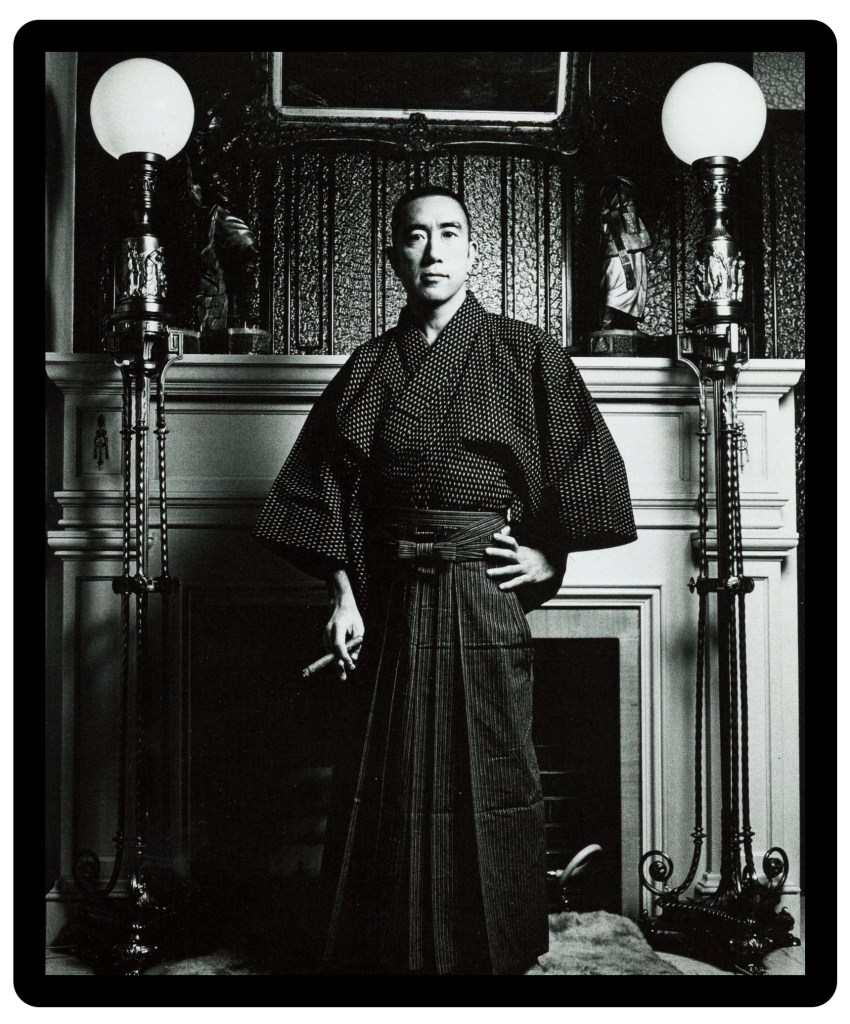
    One of the few distinctly Japanese outfits Mishima wears in the book is this traditional ensemble featuring a Jacquard patterned Kimono and striped Hakama trousers. Standing next to his Art Deco lamps and with cigar in hand, he projects an image of a gentleman who is both rakish and refined. Worldly and outward looking, yet fiercely Japanese, with the credentials to back it up. One could potentially see Mishima’s home as a work of kitsch, a kind of attempt to recreate vague material notions of what it meant to be an ‘aristocrat’. But I think there was enough taste in his curation to show that really he was a man who desired to live anachronistically, both for reasons of personal enjoyment and as a rejection of the more vulgar aspects of modernity. As such his dress sense was a rather subtle affair that blended ‘trad’ elements with a handful of contemporary ones, forming a wardrobe that would not distract, but instead compliment Mishima’s journey toward his final destination: immortality via everlasting image. It appears he may well have achieved it…

  • On The Style Of Wind In The Willows (1995)

    Jun 27th, 2024

    In an age of cinema, media production and consumer product dominated by remakes, reboots and revivals, it is not unreasonable for one to come to the rather gloomy conclusion that we have entered a phase of cultural stagnation. And certainly, it is a development currently being dissected and analysed by a whole host of contemporary philosophers, critics and internet pundits. The implications of this phenomena are perhaps as of yet unclear, but one thing that is clear to me is what these cycles are being driven by: Nostalgia. And this is not very surprising. For as we head further into a world of economic and technological uncertainty, we will inevitably gravitate toward that which brings familial comfort and warmth. In this respect, nostalgia is a particularly sweet tonic for the anxiety addled modern mind.

    I myself, am no stranger to the pursuit of such sensations. In fact, I would say a large portion of the last decade or so of my life has involved excavating the various mines of nostalgia that once laid buried in the annals of my subconscious. Yes, with the giant archiving machine that is the internet, I was able to get re-acquainted with all the Tele-visual childhood ephemera that I had once imprinted itself upon my mind. And for me, one of those things was the 1995 animated rendition of that most English of childrens stories: The Wind in The Willows.

    I have particularly fond memories of this version of the tale, as I grew up watching it on VHS in a ritualistic fashion every time I visited my grandparents house. This was certainly a more innocent and whimsical era of my life, and so too was this story of Toad, Rat, Mole and Badger. But in between the fun and adventure, and underneath the charm of the voice acting of Rick Mayall and Michael Palin, there did lie a genuinely tangible ideal of English country life, which I do still very much relate to. So this humble gem of an animated film seemed like a natural choice to revisit.

    Upon this viewership I was awash with the usual sensations and emotions that come with such nostalgia trips. The awakening of lost memories and the bittersweet reminiscences etc. I will spare you those details though, as today I wish to talk about the one thing that stood out to me in my now sartorially inclined mind. And this is the fine selection of menswear that is on display throughout the film.

    As the wind in the willows was conceived in a time in which British life was far more regimented, the wardrobe selection certainly conveys a feeling of belonging and place. The embodiment of a practical approach to dressing, born out of a sensitivity to occasion and tradition. In light of this, you will see Mr Toad in a boating blazer and straw hat when on the river. And when he is engaging in the sport of motoring, he will don a shearling leather car coat, flat cap and goggles. Then for a grand ball at Toad Hall, a tuxedo with a rather daring choice of purple cummerbund (very fitting for the rakish toad).

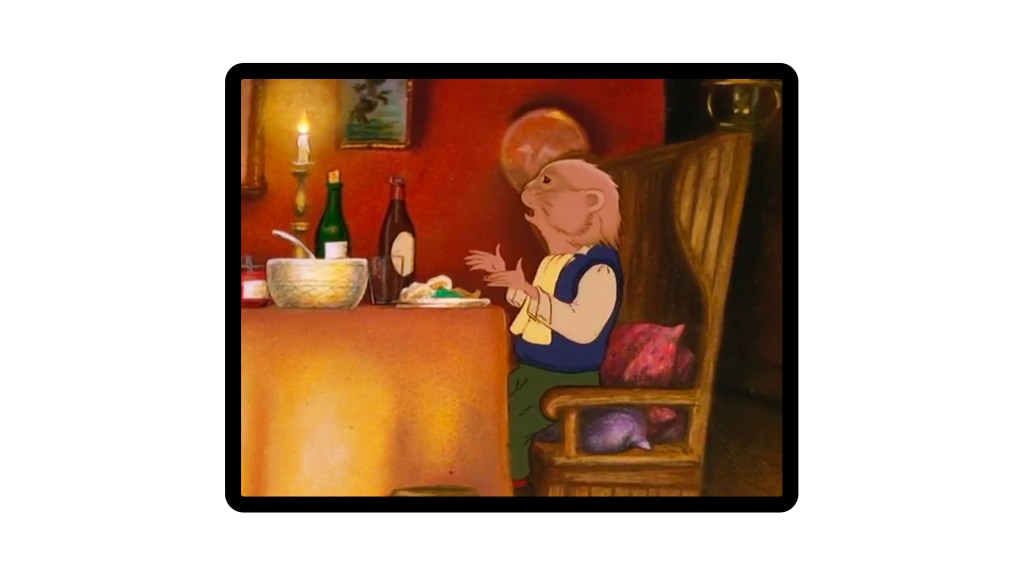
    The real master of ‘drip’ here though is the effortlessly cool Ratty. From the very start of the film we see him in a brilliant light tonal ensemble, with off white chinos, crisp white deck shoes and an ecru shirt with a very distinct pleated chest pocket that references old British army styles. Later he is seen wearing the same outfit with a tan blazer, and also accessorising with a ‘Daisy Mae’ style bucket hat in white. These are clean and elegant looks for leisurely summer days spent in the sun, reminiscent of the styling in Brideshead, but also like something you would find on a Ralph Lauren Purple Label model today.

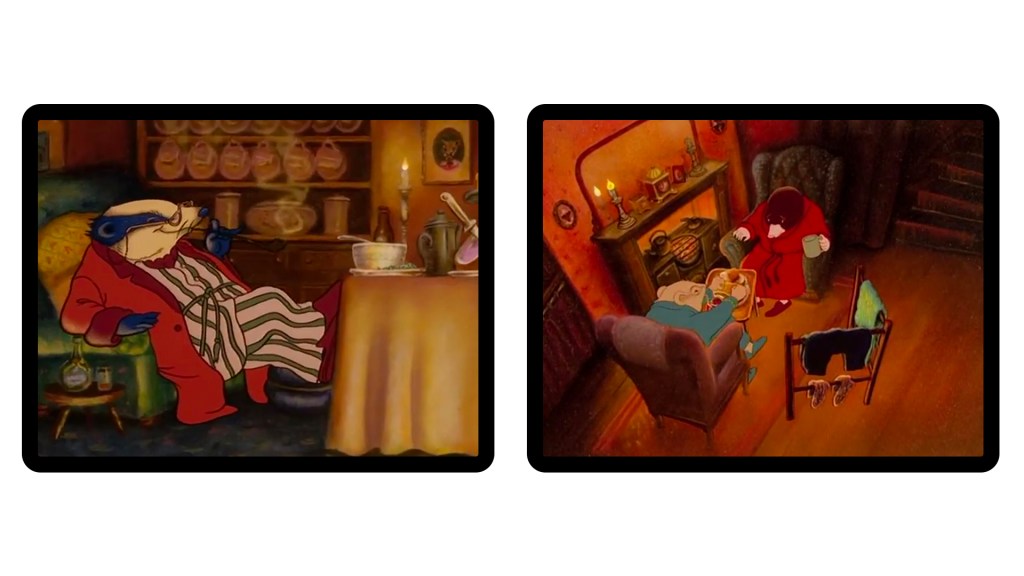
    Other Ratty highlights include his magnificent belted Norfolk jacket, which he wears with boots and gaiters whilst braving the elements in his search for Mr Mole. Later, at dinner in Badgers house, the jacket and gaiters are removed and a cosy ensemble is revealed, consisting of a Navy wool knit vest, Green moleskin trousers and a pair of very distinct Red socks (an esoteric style choice you see quite often on Jermyn Street in London).

    At this dinner, badger is shown in a state of evening ease, resplendent in striped pyjamas, a red dressing gown with turnback cuffs, slippers on and churchwarden pipe in hand. Similar getups involving shawl collar robes with rope belts and accented piping appear in other scenes. It all ends up looking like something out of an anthropomorphised New & Lingwood editorial shot…

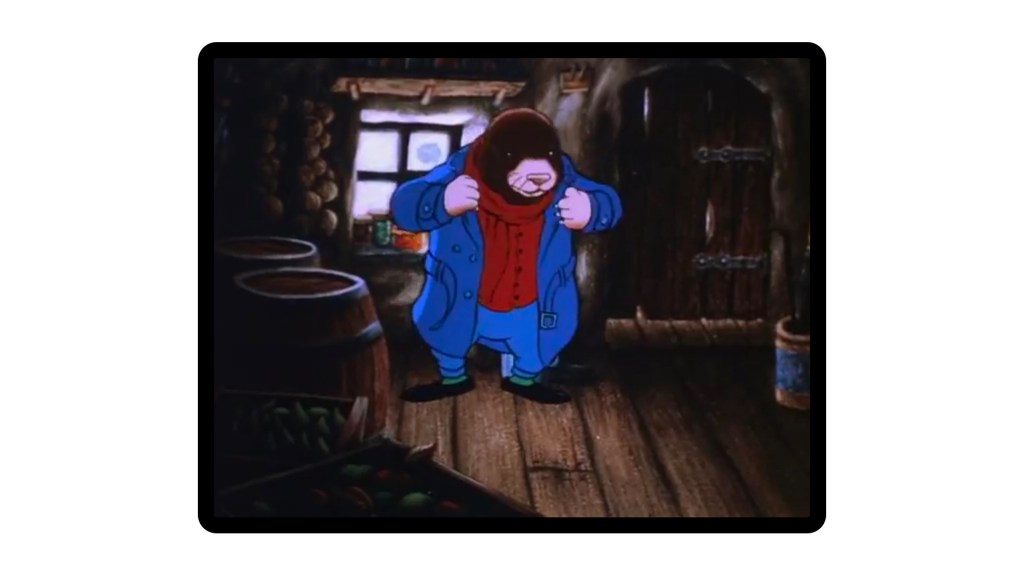
    The ever gentle Mr Mole has one or two memorable fits too. Most notable being a lovely combo of belted overcoat in a royal blue shade, with a contrasting Red scarf thrown around the neck for added warmth out in the snow. The green socks add a further pop of colour and are somehow complimented well by black loafers. To me the eccentric styling here is actually quite Parisian, and channels a ‘French Ivy’ type of look, perhaps comparable to contemporary Drake’s or old Arny’s (R.I.P).

    I now conclude my roundup of this wonderfully animated gem from the 1990s. Perhaps this Is all rather silly, musing upon such childish things for stylistic inspiration. But I do believe it warranted a spotlight, as the animators here really did such an excellent job illustrating how these styles moved on the backs of these charming creatures. The whole production to me just really spoke to an acutely British taste in colour and overall aesthetic. And whilst I do not perhaps recommend a Toad-esque Yellow Windowpane suit, I do think the overall spirit of this version is something that any aspiring aesthete can take inspiration from.

    The whole thing is available in high quality on YouTube, so have at you!

  • A Very English Jacket…Made in the USA

    Feb 10th, 2024

    It is no secret that English country style has been an eternal wellspring of inspiration for Ralph Lauren. And no clearer is this represented, than in some of the iconic editorial and catalogue imagery from the 1980s/1990s ‘Golden Era’ of Polo. For many, Ralph Lauren may well be a name which evokes an ideal of Americana, as manifested in its rugged denim offerings, faded flannel shirts and knitted sweaters with the Stars and Stripes proudly displayed. But for anyone familiar with a classic Bruce Weber campaign shot, it is clear how integral a wholly English aesthetic is to the brand. However, perhaps not unlike the English people themselves, this aspect of the brands identity can sometimes be rather understated. Especially so when it has to compete alongside bolder and more casual sportswear oriented ranges, which trade heavily off the cache of the Pony logo as an easily accessible status symbol. This reality has led to an interesting paradigm in which the brands quality ‘English’ offerings remain a sort of open secret, only to be truly appreciated by a niche of sartorially inclined connoisseurs.

    It is fascinating then to listen to this 1993 interview with Ralph Lauren himself on Charlie Rose. As, between the various anecdotes about Ralph’s life story and his career, one theme consistently arises in the conversation: English Style and it’s relation to the world of Ralph Lauren. Amidst the talk, there is also a touching tribute to Ralph found in a clip of a speech given by Audrey Hepburn at a Fashion Lifetime Achievement Award ceremony in 1992:

    “…As a designer, you conjure up all things I most care about: the country, misty mornings, summer afternoons, great open spaces, horses, corn fields, vegetable gardens, fireplaces, and Jack Russell Terriers. As a man, I respect you for your total lack of pretension.”

    The world that Hepburn speaks of here is one certainly born out of a particularly English way of life. And, that she found a resonance in Ralph’s vision, is a testament to his ability to use clothes as a touchstone with which to muse upon such ideals.

    Another telling exchange takes place halfway through the interview, in which Ralph talks about an English hacking jacket:

    “A hacking jacket represented a life that I loved. It was old England. They look great. I don’t know what it was at the time, but I said, “You know, I’d love to have that.” I couldn’t find it in the stores. I said, “Where can I get that? Where can I get it?” You couldn’t get it anywhere, so I said, “I’d like to make that.” I made it so you can wear it.”

    Now, a hacking jacket can appear to be quite an unassuming garment to the uninitiated, as at a surface level it is easy to misconstrue as a kind of odd variant of a blazer or sports jacket. But to those in the know, a hacking jacket is characterised by some lovely idiosyncratic details, usually in the form of ticket pockets, shorter lapels and a longer body with a flared skirt. Typically made up in mossy tweeds. It is a garment born out of the necessity of life on a country estate. A place where the practical concerns meet the desire for presentability, and looking ‘proper’. Subsequently, a timeless pattern is born. Ralph clearly recognised this synthesis between utility and sensibility, and how it creates garments with a certain sense of class and distinction.

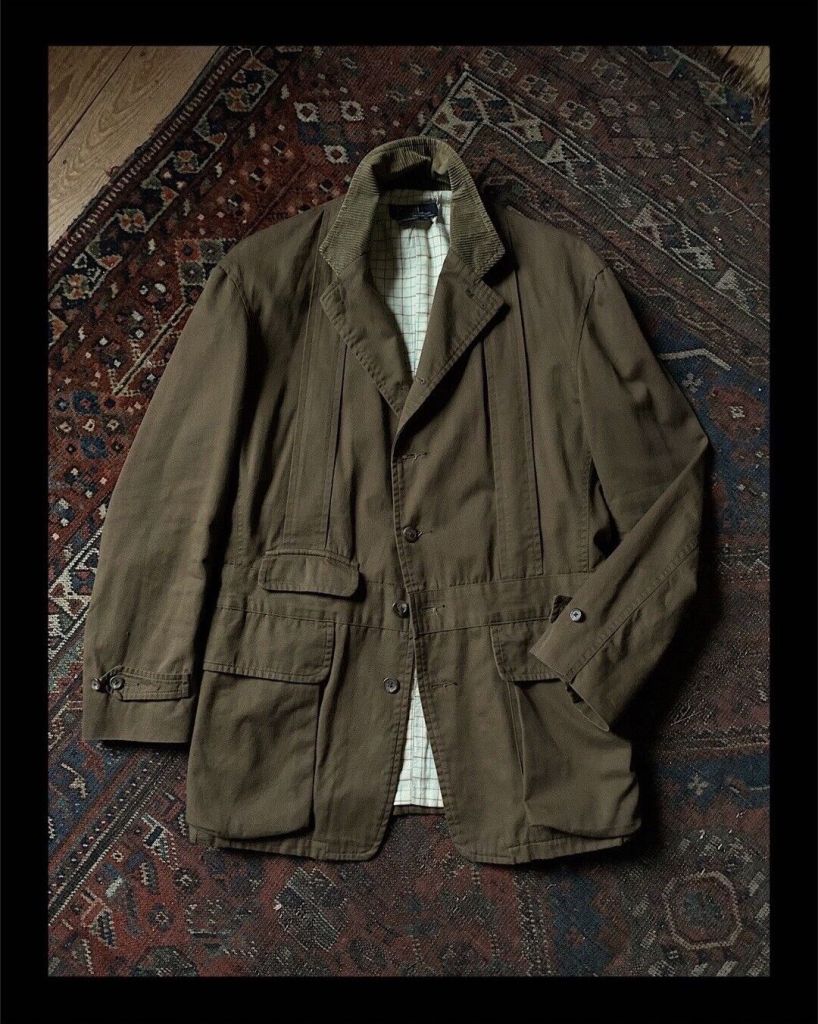
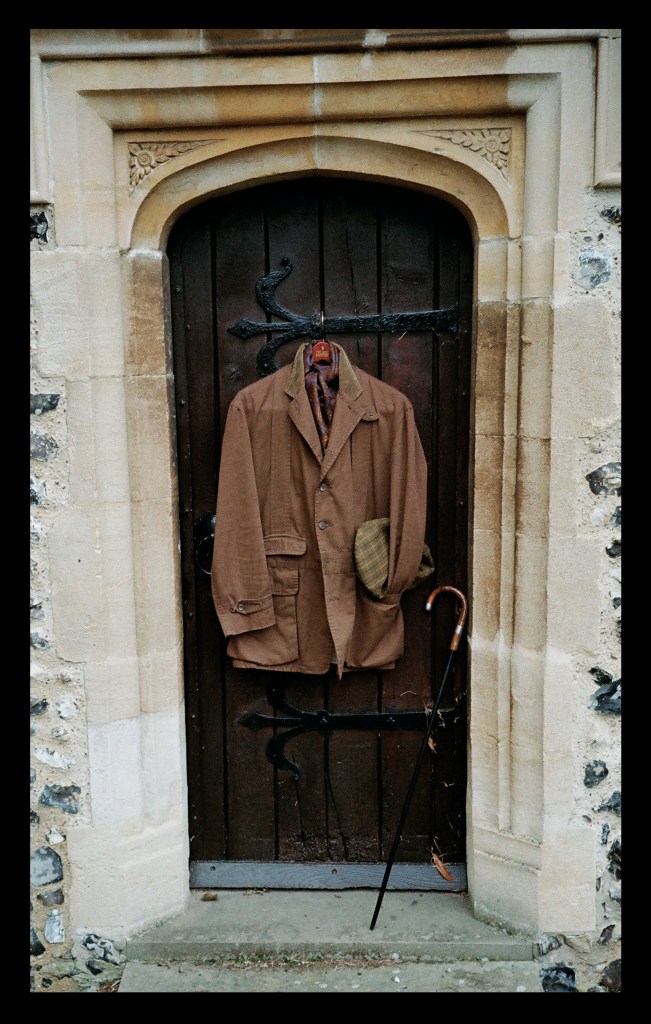
    Here today I have a beautiful original Ralph Lauren piece which perfectly captures such a design philosophy, in the form of this circa early 1990s Polo take on a classic English ‘Norfolk’ jacket.

    As Norfolk jackets go, they can be quite varied in their styling, but are most typically characterised by a belted waist and raised panels that run vertically down the front. Originally made for shooting and field sports, they often have other details which lend themselves to such pursuits, like pleated and half belt backs with swing vents, or shoulder patches for resting stocks upon. In terms of cloth, heavy tweedy wools with windowpane or gun checks would be your go to. The result is something that exudes heritage, and certainly makes a statement. But with this type of statement comes a reality, whereby it begins to look more and more out of place the further that it leaves its country home. Indeed as classic as such a garment may be, heavier tweed jackets with eccentric details can often all too easily become ‘costume’ when worn outside of very particular contexts.

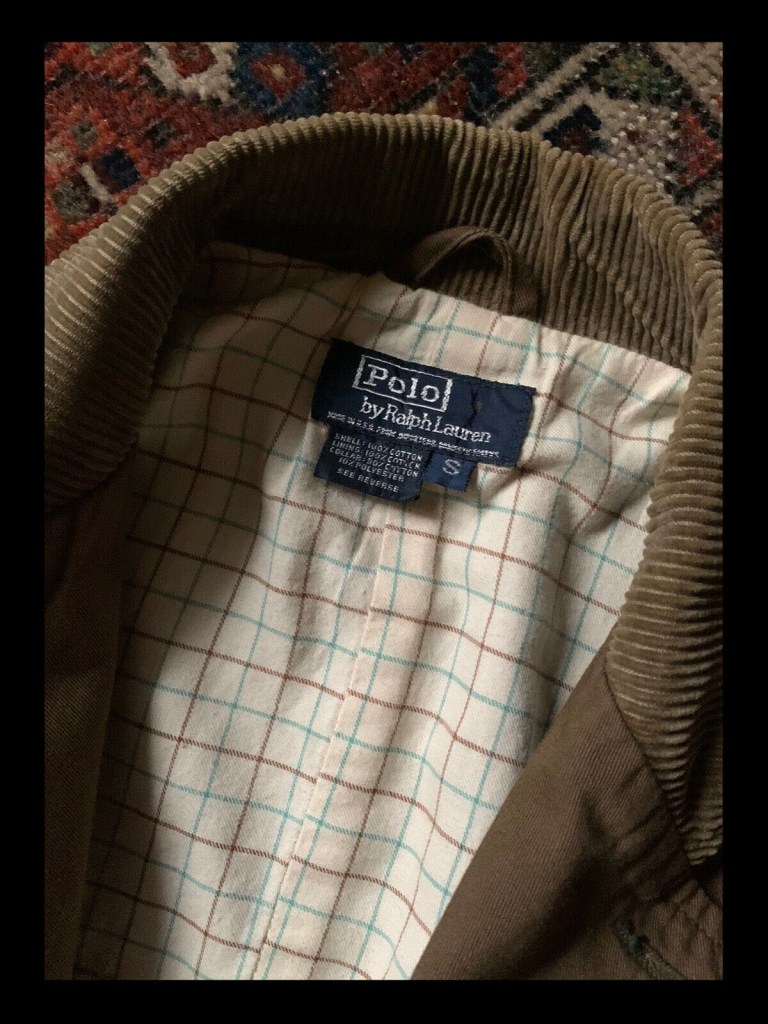
    But herein lies the genius of this old Polo piece that I am spotlighting here today. It is a scaled back Norfolk that, whilst still preserving the essence of its origin, comes to us in a far more approachable format. Made up in a mid weight Olive Green cotton twill cloth, this Norfolk is just as good for ‘knocking about in’ as it is for looking smart for a meeting on the estate. It is certainly a very ‘homely’ jacket, with a cosy Tattersall lined interior, a ticket pocket that is perfect for a bit of loose change or a matchbox, and a corduroy collar that can be worn up and fastened by a detachable throat latch on windier days. There are other more subtle details too which I enjoy, like the flared button tabs at the sleeves, and the swing vents on the arms for added mobility.

    To top it all off, the jacket bares that lovely old Polo label with ‘Made in USA’ text written underneath the logo. This is a label that denotes a certain level of quality, not as easily found in contemporary RL offerings. It is one of those little tells you always look for when on the hunt for vintage gems. When you see it, you know you are in for a treat. And this totally characterful jacket is certainly no exception. Perfect for Town and Country!

    So here I offer you: A Very English Jacket, Made in the USA.

    Available to purchase in The Sartorium shop here

  • Welcome To The Sartorium Companion Journal

    Nov 1st, 2023

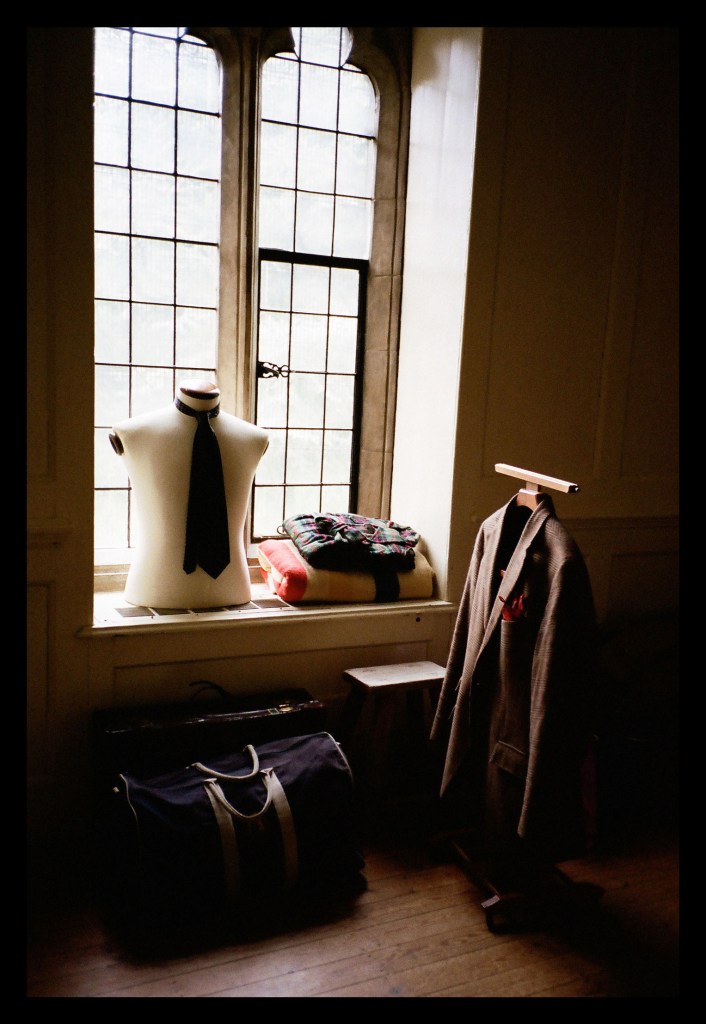
    My name is Jack, and I am the founder of the Ebay based vintage and classic menswear shop ‘The Sartorium’. I set up the shop in 2019 whilst I was working full time in menswear, and used it as a repository for the sartorial off cuts that I acquired as a result of working in the industry at the time. Over the years my shop picked up quite alot of interest online however, and last year I decided to acquire a studio space in which to go full time with my selling. One year on I have carved out a little space for myself between the studio and the Ebay shop, and now I would like to expand the franchise a little further. So today I am introducing this new journal, which will be a companion platform for the shop.

    Over the years I have sold many beautiful and special items of clothing, but as is the nature of the business, things often sell very quickly, subsequently disappearing into an Ebay aether. Gone forever! In light of this, I wanted to make a space where I could highlight some of the more unique pieces I get in, and also use them as touch points for wider conversations about style and aesthetics. I plan to pen a few articles based upon more general musings pertaining to style too, which I think may provide more contextual reference points for the clothes I sell, and the milieu that they come out of. I feel it is important to make a record here, as I do believe all of these clothes are part of a bigger story, one that can often transcend fashion. And it is these surrounding stories and ideals that I shall attempt to articulate and immortalise. First however, I would like to start with a bit of background on myself and how I got into buying, selling and collecting vintage. 

    Throughout my life, I have always been fascinated by good quality design, history, heritage and culture. And something that often intersects through all of those interests, are classic clothes and timeless style. The cultivation of which has too been a lifelong pursuit of mine. From a young age I was drawn to old clothes, things which were unique and not readily available. And as a result of having grown up in London, places like Camden Market and Brick Lane became natural stomping grounds of mine. But what started out as a novel desire to stand out from my peers by dressing in gaudy 80s/90s Sportswear, eventually blossomed into something very different. Indeed, throughout the years I went on somewhat of a journey with my own personal style, but it was not until I started working in the the menswear industry proper (first for Polo Ralph Lauren, and then for Drake’s), did I truly begin to get a real sense of what ‘dressing well’ meant.

    For it was in this period that I was fortunate enough to be working in and around central London. And, as anyone who knows central London well, there are certain streets, certain avenues and enclaves that are real sartorial havens. Places like Savile Row, Clifford Street, The Piccadilly Arcade and Jermyn Street, all became regular destinations for me. Not just for the traditional shops that sold fine English made shoes or immaculately tailored suits, but also for the atmosphere and mood that they imbibed. In these places one finds men (and women too), who speak, act and indeed dress in particular ways. Ways that are idiosyncratic, often parochial, sometimes eccentric. And although it is perhaps the stylistic affectations and accoutrements on display in these spaces that one notices foremost, the meaning underneath it is really about something deeper. To me it revealed a specific way of life and outlook, whose origins lie mostly in England, Italy and France. A material manifestation of a sensibility that came from a real sense of belonging. Certainly to me, the sight of these very well dressed people stood in stark contrast to the cyclical and arbitrary nature of contemporary fashion, which is worn more often than not for show by the trend obsessed. In these quieter streets of central London however, I saw expressions that were more timeless. And I simply found it all rather appealing!

    In the midst of such sights I underwent a real sartorial education. One that very much informed my tastes for dressing, and the curation that you see in The Sartorium today. Over the years I have been able to offer a little slice of Savile Row and Jermyn street in my humble corner online, and have helped people across the world to accent their wardrobes with genuinely special pieces. I am proud to have been of such service. However, I have always wanted to make something more of it all. And, as I have previously outlined, I want this blog to be a space for that purpose. A small repository for my thoughts, and some fine visuals that I hope you will appreciate…

    Yours sincerely.

    – Jack Simpson

Blog at WordPress.com.


Loading Comments...
 

    • Subscribe Subscribed
      • The Sartorium Companion Journal
      • Already have a WordPress.com account? Log in now.
      • The Sartorium Companion Journal
      • Subscribe Subscribed
      • Sign up
      • Log in
      • Report this content
      • View site in Reader
      • Manage subscriptions
      • Collapse this bar